
Solar Panels for a Semi-Detached House in the UK: Costs, System Size and Savings
Solar panels can be an excellent fit for a semi-detached house in the UK, provided your part of the roof has enough usable space and is not heavily shaded. Sharing one wall with a neighbour does not reduce solar performance; roof orientation, condition, shading and electricity use matter far more.
For many two- and three-bedroom semi-detached homes, a system of roughly 3–5 kWp is a sensible starting point. The final design may use one roof slope, two orientations, an extension or a garage. This guide explains likely panel numbers, costs, savings, batteries, planning considerations and how to compare quotations.
Get a free home solar survey: Simple Green Energy can assess your roof, electricity use and future plans, then provide a property-specific system design and savings estimate.
Get Your Solar Panel Quote
Start with your address so we can check the best solar options for your home.
Quick answer
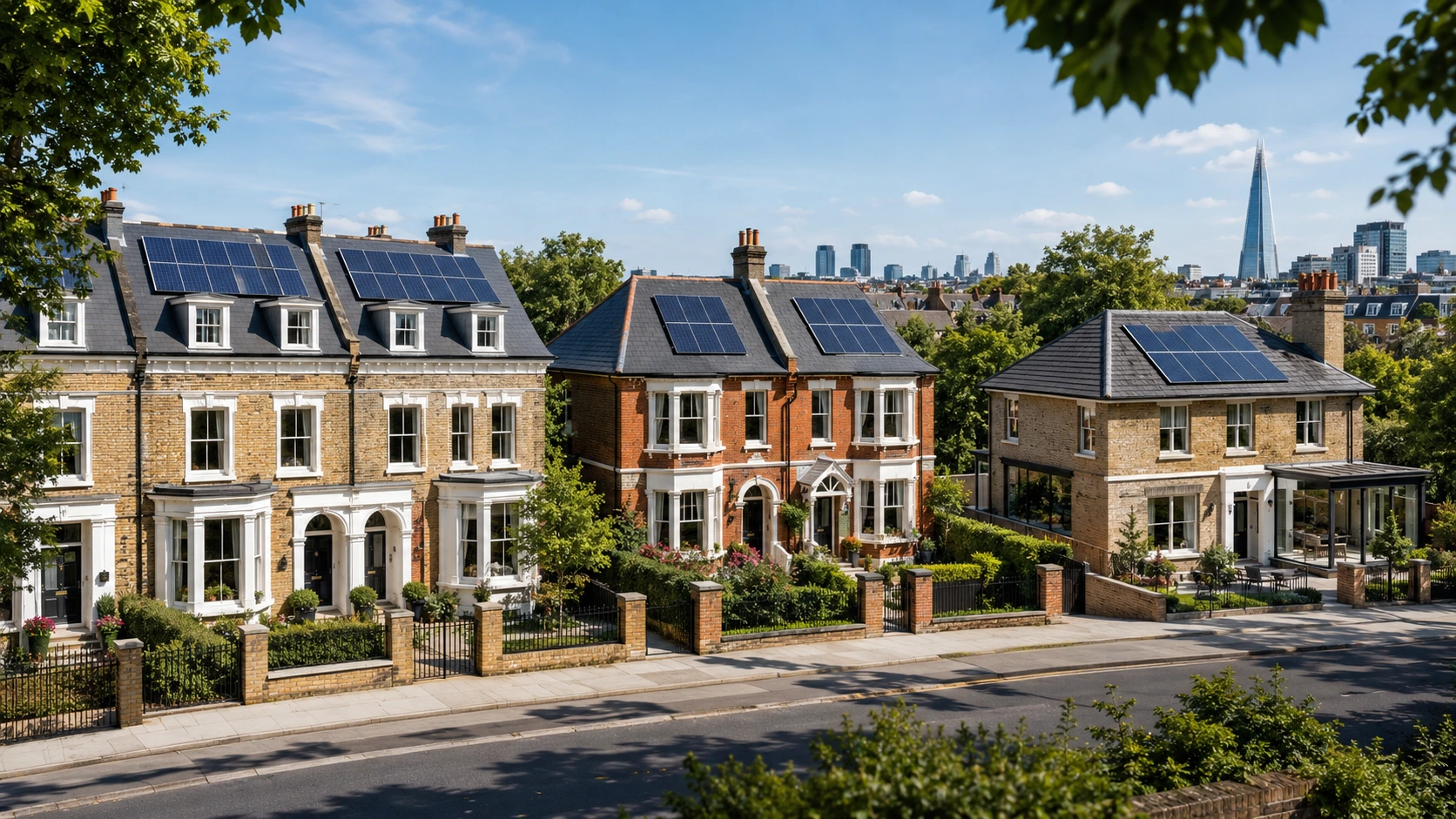
A typical semi-detached house can accommodate solar panels without any special disadvantage compared with a detached home. An average UK domestic system is around 4.5 kWp, uses approximately 12 panels and needs about 20–30m² of roof area. A semi-detached home may need a smaller or split array where chimneys, hips, dormers or adjoining roof features restrict the available space.
Many suitable installations cost approximately £5,500–£9,000, while the Energy Saving Trust currently quotes about £7,600 for an average 4.5 kWp system. Actual savings depend on generation, daytime electricity use and export payments, so a tailored survey is essential.
Table of Contents
ToggleQuick comparison: typical options
| Option | Typical size | Best for | Main strength | Consideration |
|---|---|---|---|---|
| Compact array | 3–3.6 kWp | Smaller roofs or lower electricity use | Lower upfront cost | Less capacity for an EV or heat pump |
| Balanced system | 4–4.5 kWp | Many family semi-detached homes | Good balance of cost and output | May need two roof faces |
| Larger system | 5 kWp+ | High-use households, EV owners or home workers | Greater annual generation | Roof space and DNO approval |
| Solar plus battery | PV sized to roof; battery sized to usage | Evening-heavy electricity use | Stores daytime surplus | Higher cost and shorter battery lifespan |
Are solar panels suitable for a semi-detached house?
Usually, yes. Many semi-detached properties have pitched front and rear roof slopes, with possible additional space on an extension, garage or outbuilding. Your installer should assess only the roof area you own or have permission to use.
The main considerations are:
- Orientation: A south-facing roof is ideal for maximum annual generation, but east- and west-facing roofs can remain viable. Energy Saving Trust estimates suggest east- or west-facing systems may generate around 15–20% less than an equivalent south-facing system. An east/west layout can, however, spread generation across the morning and afternoon.
- Shading: Chimneys, trees, dormers and adjoining roof features can cast shadows. Optimisers or microinverters may help where shading is uneven, but they should be recommended for a clear design reason rather than added automatically.
- Roof condition: Solar panels should last 25 years or more. Necessary repairs or replacement roofing are usually best completed before installation to avoid paying to remove and refit the array later.
- Usable area: Hips, valleys, roof windows and safe access requirements reduce the available capacity. Panel numbers should come from a measured layout rather than total roof dimensions.
- Ownership: Leaseholders, shared-ownership residents and homes with unusual title boundaries may need permission from a landlord, freeholder or management company.
What size system does a semi-detached house need?
Do not size solar panels by bedroom count alone. Start with your annual electricity consumption in kilowatt-hours, when that electricity is used and what may change during the system’s lifetime.
A household using approximately 2,000–3,000 kWh a year might consider a 3–4 kWp system. A family using 3,500–5,000 kWh, charging an electric vehicle or working from home may justify 4–6 kWp where the roof and network connection allow it.
These are design starting points, not quotations. The Energy Saving Trust identifies approximately 4.5 kWp as the current average domestic system size.
Higher-wattage panels can be valuable where roof space is limited. On a larger, simple roof, layout, warranty, manufacturer support and total installed value may matter more than selecting the panel with the highest quoted efficiency.
Every proposal should state:
- Total system capacity in kWp
- Estimated annual generation in kWh
- Shading assumptions and predicted losses
- Expected self-consumption and export
- Panel, inverter and battery warranties
- Proposed equipment and cable locations
- Electricity-price and export-rate assumptions used
How to choose the right solar panel system
- Check 12 months of electricity bills. Include planned changes such as an EV, induction hob, home office, air conditioning or heat pump.
- Survey every usable roof face. The best layout may combine front, rear, extension or garage roofs rather than concentrating panels on one slope.
- Compare annual generation. Focus on predicted kWh output using consistent location and shading assumptions, not panel count alone.
- Check the inverter design. The inverter must suit the array capacity, roof orientations and any battery or future expansion plan.
- Compare warranties carefully. Separate the panel product warranty, performance warranty, inverter warranty, battery warranty and installer workmanship cover.
- Plan for future consumption. Adding panels later can require new scaffolding, another network application and equipment compatibility checks.
- Compare complete prices. Confirm whether scaffolding, monitoring, bird protection, electrical upgrades and network-related work are included or excluded.
Solar panel costs, savings and payback
The cost of solar panels for a semi-detached house depends on capacity, roof access, scaffolding, roof complexity, equipment quality and required electrical work.
Current consumer guidance places many 3–4 kW installations between approximately £5,000 and £8,000. The Energy Saving Trust’s current average for a 4.5 kWp domestic system is around £7,600.
| System | Indicative installed cost | Suitable for | Financial note |
|---|---|---|---|
| 3–3.6 kWp solar PV | £5,000–£7,000 | Compact roof or lower usage | Fixed installation costs can make a larger array better value |
| 4–4.5 kWp solar PV | £6,500–£9,000 | Typical family semi | Often the balanced option where 10–12 panels fit |
| 5 kWp+ solar PV | £7,500–£11,000+ | High usage, EV or heat-pump plans | Model generation and exports carefully |
| Add approximately 5 kWh of battery storage | Commonly £3,000–£5,500 extra | Evening-heavy usage or smart tariffs | Calculate battery payback separately |
These figures are broad market allowances rather than Simple Green Energy quotations. An accurate price requires a property survey, confirmed roof layout and electrical assessment.
Solar panels save money in two ways. Electricity used directly in the home reduces the amount bought from the grid, while unused generation may earn export income.
Under the Smart Export Guarantee, eligible small-scale generators can receive payment for measured electricity exports. Suppliers decide their own rates, contract periods and conditions, so homeowners should compare export tariffs rather than automatically using their existing electricity supplier.
Payback is not one fixed UK figure. It changes according to location, orientation, shading, installation price, household routine and export rate. Energy Saving Trust examples using July 2026 energy prices indicate payback periods of approximately nine to twelve years across several Great Britain locations.
Treat precise savings promises cautiously unless the quotation clearly shows the generation, electricity-price, self-consumption and export assumptions behind them.
Batteries, EVs and winter performance
A solar battery may suit a home that exports substantial electricity during the day but imports power in the evening. It can also charge during cheaper tariff periods where the equipment and electricity tariff support this approach.
Compare solar-only and solar-plus-battery projections. The assessment should include usable battery capacity, charging losses, degradation, warranty limits and likely replacement timing. Batteries generally have a shorter working life than solar panels.
For EV owners, direct daytime solar charging can be particularly valuable. A compatible smart charger can increase or reduce charging power according to available surplus generation. This may offer better value than simply purchasing the largest possible home battery.
Solar panels continue generating on cloudy days and during winter, but winter output is considerably lower because daylight hours are shorter and the sun remains lower in the sky. Most homes will continue relying on the grid throughout the year.
Planning permission, neighbours and grid connection
Roof-mounted solar panels are usually permitted development, but limits and conditions apply. Listed buildings, conservation areas, national parks and unusual roof positions require additional checks. Planning rules also differ across the UK, so the relevant local authority should confirm the position where there is uncertainty.
A standard system installed entirely on your own roof does not normally require your neighbour to participate. The design should remain within your ownership and avoid unsafe access or damage. Obtain property-specific professional advice where roof ownership, title boundaries or shared structural work are unclear.
The installation must comply with applicable building and electrical requirements and be registered with the Distribution Network Operator. Your installer will normally manage this process. Larger systems or certain inverter arrangements may require approval before work begins rather than notification afterwards.
Why the installer matters
Panel brand is only one part of system performance. Roof layout, shading analysis, mounting, weatherproofing, cable routing, inverter design, commissioning and monitoring all affect safety, output, reliability and lifespan.
Use an MCS-certified installer and request the system design, generation estimate, certification and full handover pack. Confirm workmanship protection, electrical certification, DNO documents, warranty support and responsibility for aftercare.
MCS forms part of the UK’s quality-assurance framework for small-scale renewable installations. Smart Export Guarantee providers may request an MCS certificate or equivalent evidence that the system meets an accepted installation standard.
A good installer should explain why each component has been selected and show the assumptions behind projected savings instead of relying on headline claims.
Example recommendation for a UK semi-detached house
Consider a three-bedroom semi-detached home with a mostly unshaded south-west rear roof, annual electricity consumption of 3,400 kWh and occupants away during much of the working day.
A sensible starting design might be approximately 4–4.5 kWp, subject to a measured roof layout. The homeowner should compare a solar-only system with a modest battery using half-hourly smart-meter data where available.
If the household plans to purchase an electric vehicle, using more of the suitable roof space during the initial installation may provide better long-term value. If a chimney near the party line causes shading, a revised layout or panel-level electronics may outperform simply installing the maximum number of panels.
Frequently asked questions (FAQs)
Clear answers about solar panels for semi-detached houses, panel numbers, neighbour permissions, planning rules, costs, payback, roof direction and battery storage. Speak to Simple Green Energy .
Planning solar for a semi-detached house?
Speak with Simple Green Energy about roof space, panel capacity, boundaries, planning considerations, expected generation, costs and whether battery storage suits your household.
Assess my home for solarFinal verdict
Solar panels are usually worth investigating for a semi-detached house in the UK. A structurally sound roof with limited shading can reduce grid purchases and provide export income.
The best option is not necessarily the largest system or the cheapest quotation. It is the system matched to your usable roof area, measured electricity consumption, household routine and future plans.
Book a free home survey with Simple Green Energy for a roof assessment, proposed panel layout, generation forecast and itemised quotation. This evidence will show whether solar-only, solar plus battery or a future-ready system offers the best value for your home.