
Solar Panels on an East-West Roof in the UK: Are They Worth It?
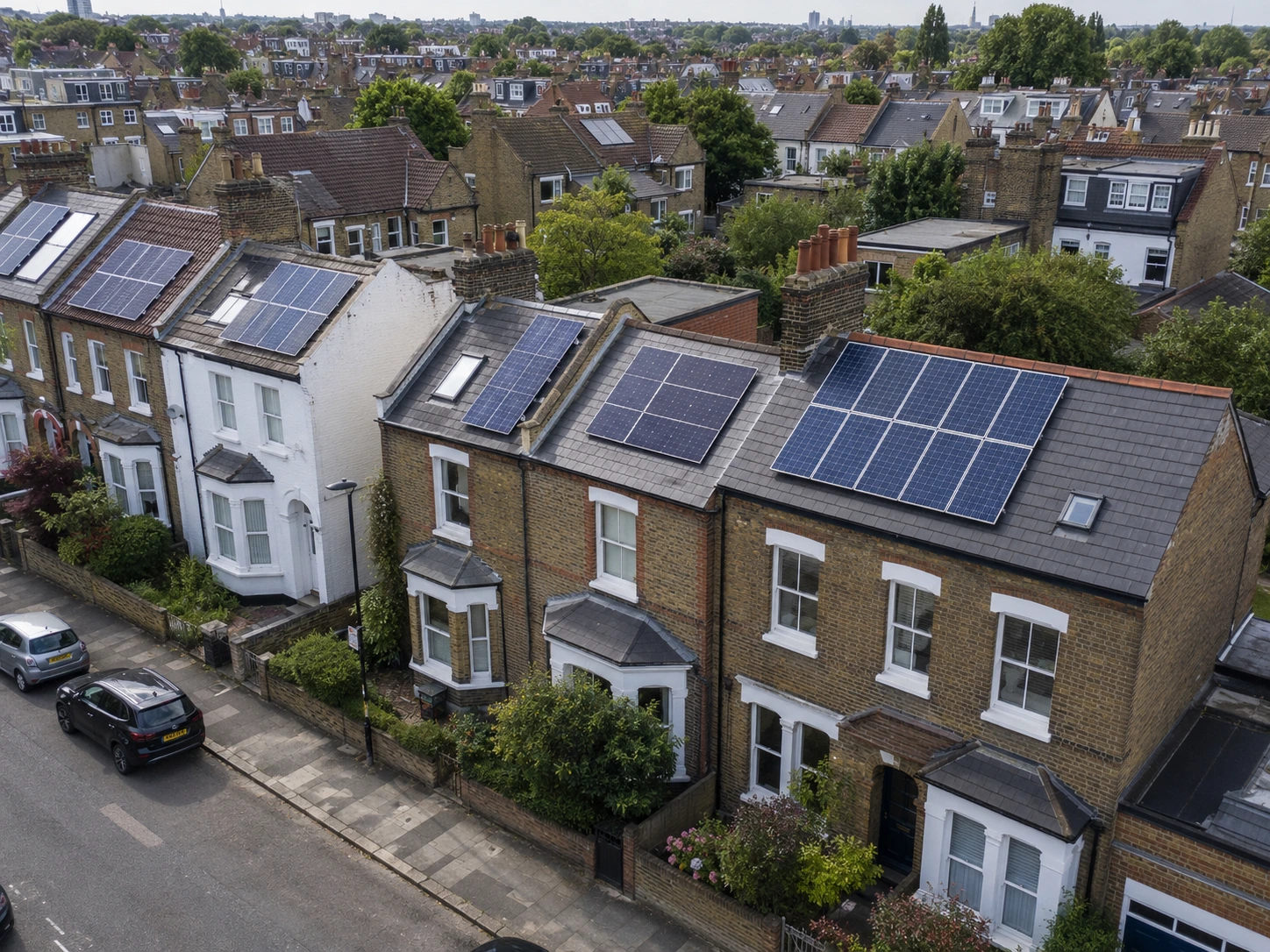
Solar panels can work very well on an east-west roof in the UK. A south-facing roof normally produces the highest annual output, but east-facing panels favour the morning, while west-facing panels favour the afternoon and early evening.
Energy Saving Trust estimates that an east- or west-facing solar array typically generates around 15–20% less electricity than an equivalent unshaded system facing directly south.
That difference does not tell the whole story. An east-west layout can spread generation across more of the day, use both sides of the roof and better match household electricity demand. For families, home workers and EV owners, a well-designed east-west system may deliver stronger practical value than its annual generation figure suggests.
This guide covers likely output, system design, costs, batteries, payback, planning and the questions to ask an installer.
Get Your Solar Panel Quote
Start with your address so we can check the best solar options for your home.
Quick answer
Yes, solar panels are usually worth considering on an east-west roof in the UK. Compared with the same capacity facing due south, an east- or west-facing array commonly produces around 15–20% less annual electricity. However, a system split across both roof slopes generates earlier in the morning and later in the day, creating a broader output curve.
That can increase the proportion of solar electricity used in the home, particularly where electricity consumption is higher before work, after school or during the early evening. The best result depends on roof pitch, shading, location, panel count, inverter design, electricity consumption and export payments.
Table of Contents
ToggleEast-west versus south-facing solar panels
| Factor | East-west roof | South-facing roof |
|---|---|---|
| Annual generation per kWp | Usually around 15–20% lower for each east or west orientation | Usually the highest |
| Daily generation pattern | Broader morning and afternoon/evening output | Stronger peak around midday |
| Self-consumption | Often suits morning and evening demand | Suits homes with high daytime demand |
| Available roof space | Both slopes can be used, potentially accommodating more panels | Limited to the south-facing area |
| Winter performance | Still generates, but lower sun angles reduce output | Usually stronger during winter |
| System design | Requires separate modelling and a suitable inverter configuration | Usually simpler |
These are general comparisons. Shading, roof pitch and local weather can have a greater effect than orientation alone.
Do east-west solar panels work in the UK?
Solar photovoltaic panels generate electricity from daylight rather than heat. They continue producing electricity in cloudy weather, although their output is lower than in strong, direct sunlight.
Roof direction changes how much electricity is generated and when that electricity becomes available. It does not determine whether the panels work.
Energy Saving Trust describes an unshaded south-facing roof as ideal but confirms that east- and west-facing roofs remain suitable. It also warns that shading may have a larger effect than orientation. An unshaded east-facing slope could therefore outperform a south-facing slope heavily shaded by trees, chimneys or nearby buildings.
MCS performance calculations account for the property’s location, panel orientation, roof pitch and shading. Under the MCS convention, due south has an azimuth of 0°, while due east or west has an azimuth of 90°. Your quotation should show separate estimates for the east- and west-facing sections rather than one unexplained generation figure.
What generation pattern should you expect?
An east-facing array starts generating earlier and is strongest before midday. A west-facing array begins more slowly but continues producing further into the afternoon and early evening.
Together, the two roof slopes create a wider and generally flatter generation profile than a south-facing system. This can be useful for households that consume electricity at several points throughout the day rather than mainly around lunchtime.
Electricity used while the panels are generating normally reduces the amount purchased from the grid. Electricity that is not used or stored can be exported.
In Great Britain, the Smart Export Guarantee allows eligible small-scale generators to receive payments for electricity exported to the grid. Electricity suppliers set their own rates, contract periods and conditions, so tariffs should be compared carefully.
An east-west system can generate over a long period during summer. In winter, output from every UK solar installation falls because days are shorter and the sun is lower. A south-facing roof normally has an advantage during this period, so request monthly forecasts rather than relying solely on an annual total.
Inverters, strings and shading
East and west roof slopes receive different levels of sunlight at the same time. The electrical design must accommodate that difference.
A common approach is a string inverter with separate maximum power point tracker, or MPPT, inputs. These allow roof sections with different orientations to be controlled independently.
Manufacturers also offer inverter configurations designed for multiple roof orientations. Fronius, for example, explains that multiple MPPTs can accommodate east-west arrays and differently sized roof sections.
Microinverters or power optimisers may be appropriate where there are:
- Several roof faces
- Unequal panel groups
- Chimneys or rooflights
- Unavoidable partial shading
- A requirement for panel-level monitoring
They are not automatically necessary for every east-west installation. Their additional cost should be supported by a clear design benefit. Energy Saving Trust notes that optimisers can reduce the effect of individual shaded panels, but may not increase generation on an otherwise unshaded roof.
Ask your installer how many panels will be fitted to each slope, whether the orientations have independent tracking, how shading has been calculated and whether the monitoring platform separates the two roof sections.
How to choose the right east-west solar system
Survey both roof slopes
Measure the usable area and identify chimneys, valleys, rooflights, aerials and seasonal shading.
Understand your electricity use
Morning-heavy homes may benefit from greater east-facing capacity. Homes with higher afternoon consumption may benefit from more west-facing panels.
Compare several layouts
Ask for the maximum sensible panel layout and at least one smaller alternative. More generation is useful, but the largest system is not automatically the most financially attractive.
Check the roof condition
Repair ageing tiles, felt, battens or flat-roof coverings before installing equipment expected to remain in place for decades.
Review the inverter design
Confirm how each orientation is managed and whether the proposed inverter will support a future battery.
Compare warranties properly
Review panel product warranties, performance warranties, inverter cover and the installer’s workmanship guarantee. Establish who handles a claim if equipment fails.
Request an MCS performance estimate
The estimate should use the property’s postcode zone, panel orientation, pitch and shade factor. MCS states that these variables must be considered when estimating output.
Assess lifetime value
Consider self-consumption, export income, equipment replacement, maintenance and finance costs—not simply the first-year savings figure.
Costs, savings and payback
Energy Saving Trust’s current reference figure is approximately £7,600 for a typical 4.5kWp domestic solar installation. Battery storage commonly adds around £5,000–£8,000. Figures were checked in July 2026.
East-west pricing may be similar to a straightforward south-facing installation, although additional mounting, cabling, scaffolding complexity or power electronics could increase the quotation.
| Cost or value factor | UK guide figure or likely impact |
|---|---|
| Typical 4.5kWp domestic solar installation | Around £7,600 |
| Typical home battery | Around £5,000–£8,000 |
| East-west design additions | Quote-specific; potentially extra rails, cabling, MPPT capacity or optimisers |
| VAT | Qualifying residential installations are temporarily zero-rated until 31 March 2027 |
| Exported electricity | May earn SEG payments in Great Britain; rates vary |
| Accurate payback | Requires a survey, generation model, usage profile and tariff assumptions |
The temporary zero rate of VAT applies to qualifying residential energy-saving installations until 31 March 2027, after which the rate is currently scheduled to return to 5%.
Payback is not simply the installation price divided by annual generation. A unit of solar electricity used in the home has the value of the grid electricity it replaces. An exported unit has the value of the export tariff.
A wider east-west generation window can improve self-consumption and partly compensate for lower generation per panel.
Be cautious with quotations that:
- Assume unrealistically high self-consumption
- Ignore possible inverter replacement
- Use a promotional tariff throughout the calculation
- Exclude panel degradation
- Present only the most optimistic scenario
Ask for conservative, central and optimistic savings projections. An accurate quotation always requires a property survey and household-specific modelling.
Should you add a battery or EV charger?
A battery stores surplus solar generation for use later in the day. It may suit homes that are empty during daylight hours or where imported electricity costs significantly more than exported electricity earns.
However, a battery is not automatically the fastest-payback option. Compare the solar-only and solar-plus-battery calculations separately.
EV owners benefit most when the car is at home during daylight and the charger can vary its charging rate to follow surplus solar. A west-facing array may support afternoon charging particularly well, while east-facing panels may suit vehicles parked at home during the morning.
Many solar systems can have a battery added later, subject to inverter compatibility, available space and electrical design. Planning ahead can reduce future disruption and avoid unnecessary equipment replacement.
Planning permission and roof suitability
Domestic rooftop solar is frequently classed as permitted development, meaning a planning application is not normally required. However, important limits and conditions apply. Listed buildings, conservation areas, flats and unusual mounting positions may require additional checks. Planning rules also differ across the UK.
The roof must be structurally suitable and have sufficient remaining life. Removing solar panels to replace the roof later adds avoidable cost.
A competent survey should consider:
- Roof covering and supporting structure
- Fixing method and weatherproofing
- Wind loading
- Fire safety
- Cable routes
- Inverter and battery location
- Safe maintenance access
The solar installation must also be registered with the relevant Distribution Network Operator. The installer will normally manage the notification or application.
Why the installer matters
High-efficiency panels cannot compensate for poor surveying, mounting or electrical design.
Installation quality affects:
- Weatherproofing
- Wind resistance
- Cable safety
- Inverter operation
- System monitoring
- Warranty validity
- Long-term generation
- Fire and electrical safety
Choose an installer that supplies a transparent panel layout, product datasheets, MCS performance estimate, structural checks where required, written scope of work, DNO documentation, commissioning records and workmanship warranty.
Ask who will complete the installation, who will support the system afterwards and how faults will be diagnosed.
Frequently asked questions (FAQs)
Clear answers about east- and west-facing solar panels, split-roof arrays, seasonal generation, inverter design, MPPT inputs, microinverters and optimisers. Speak to Simple Green Energy .
Considering an east-west solar array?
Speak with Simple Green Energy about roof direction, shading, morning and evening electricity use, expected annual output and the most suitable inverter configuration for your property.
Assess my roof orientationAre east-west solar panels worth it?
For many UK homes, yes.
An east-west system normally produces less electricity per installed kilowatt than an equivalent south-facing system. However, it can use more available roof space, generate across a longer part of the day and align well with real household electricity demand.
The best system is not necessarily the one with the most panels or the shortest advertised payback. It is the system that delivers the strongest combination of usable generation, sensible capital cost, reliable equipment and professional installation.
Compare at least two properly modelled layouts and insist on realistic assumptions.
Book a free home survey with Simple Green Energy to compare east-only, west-only and combined east-west layouts before committing to an installation.