


Solar Panel Grants UK 2026: Eligibility & How to Apply
Searching for “free solar panels” in 2026 can be confusing. Some websites promise full funding, while others promote loans or suggest that every homeowner qualifies. Genuine support does exist, but there is no single solar panel grant available across the whole UK.
In England, eligible privately owned homes may receive fully funded panels through the Warm Homes: Local Grant. In Wales, solar may be included within a wider package of improvements through the Nest programme. Scotland and Northern Ireland have different funding arrangements, eligibility rules and application routes.
This guide, checked in July 2026, explains the support available in each UK nation and separates grants from loans, 0% VAT relief and Smart Export Guarantee payments. First, does a universal UK solar panel grant actually exist?
Quick Answer: Is there a universal UK solar panel grant in 2026?
No. Solar funding is not the same across the UK. England, Wales, Scotland and Northern Ireland each have different schemes, eligibility rules and application routes. Some households may receive fully funded panels, while others may only qualify for loans, local support, VAT relief or export payments.
Table of Contents
ToggleAre There Solar Panel Grants in the UK in 2026?
Yes, solar funding is available in the UK, but there is no unrestricted grant open to every household. Support is usually targeted using factors such as income, qualifying benefits, EPC rating, tenure, location and whether the property is suitable. Some schemes may fully fund solar panels, while others provide partial funding, loans or wider home-energy improvement packages.
“UK solar panel grant” is therefore an umbrella search term, not the name of one national programme. England, Wales, Scotland and Northern Ireland each operate different schemes and application routes, and availability may also depend on council or programme budgets. Meeting the basic eligibility rules does not guarantee solar panels, as a property assessment will normally decide which improvements are appropriate and cost-effective.
Solar Panel Funding in 2026 at a Glance
| Area | Main funding route | Can solar be included? | Where to start | Key limitation |
|---|---|---|---|---|
| England | Warm Homes: Local Grant, ECO4 and social-housing funding | Yes, where recommended after an assessment | GOV.UK, your local council, energy supplier or landlord | Eligibility does not automatically guarantee solar panels. Funding availability and property suitability must also be assessed. |
| Wales | Nest and Green Homes Wales | Yes | Nest or Green Homes Wales | Nest may fully fund eligible improvements, while Green Homes Wales is mainly a loan-based route. |
| Scotland | Home Energy Scotland advice and Funding Finder | Sometimes | Home Energy Scotland | Available support may be local, technology-specific or provided through a loan rather than a grant. |
| Northern Ireland | Northern Ireland Energy Advice and regional schemes | Limited and scheme-dependent | Northern Ireland Energy Advice or the Housing Executive | There is currently no general solar panel grant available to every household. |
| UK-wide alternatives | 0% VAT and Smart Export Guarantee | Yes, but these are not grants | A solar installer and participating energy supplier | Zero-rated VAT reduces the installation cost, while the Smart Export Guarantee pays for eligible electricity exported to the grid. |
Which Solar Panel Grants Are Available in England?
England does not offer a solar grant that every homeowner can claim. The main routes are the Warm Homes: Local Grant for eligible private households, ECO4 for fuel-poor or vulnerable households, and landlord-led funding for qualifying social homes.
Warm Homes: Local Grant
Quick answer: This is one of the clearest routes to fully funded solar panels in England. However, solar is only offered when the council’s survey finds it suitable for the property and available funding allows it.
You may qualify when:
- Your home is in England and is owner-occupied or privately rented.
- Its EPC rating is D, E, F or G.
- Your household income is usually £36,000 or less.
- Alternatively, you qualify through certain benefits or an eligible postcode.
How to apply
- Complete the official eligibility application.
- Wait for your council to contact you and arrange a survey.
- Review the improvements recommended for your home.
The council organises and pays for agreed work. Owner-occupiers normally pay nothing, although private landlords may need to contribute.
Local availability: Funding levels, priorities and waiting times vary by council. Passing the initial checks does not guarantee solar panels.
Can ECO4 Pay for Solar Panels?
What ECO4 is: An energy-supplier obligation supporting low-income, fuel-poor and vulnerable households across Great Britain.
What it is not: A fixed-value grant that lets applicants request standalone solar panels.
Households may qualify through certain benefits or ECO4 Flex, including defined income and health-related routes. Solar PV is permitted only in specific circumstances—usually alongside suitable electric heating and as part of a compliant retrofit package. The supplier or delivery partner decides what the property requires after assessment.
ECO4 runs until 31 December 2026. Receiving a qualifying benefit does not guarantee funding, and there is no standard consumer grant amount.
Are Government-Backed Solar Loans Available in England?
The Warm Homes Loan Scheme is a finance programme, not a grant. The government was still selecting participating lenders, with public loan products expected from September 2026, subject to approval. Check the official scheme status before stating that household applications are open.
Who Is Most Likely to Qualify for Solar Panel Funding?
You may have a stronger chance of qualifying if…
- You live in an area with an active scheme and available funding.
- You are an owner-occupier, private tenant or social tenant covered by the programme.
- Your household has a low income or receives means-tested benefits.
- Someone in the home has a qualifying health vulnerability.
- Your property has a low EPC rating, often D to G.
- Your postcode or council tax band meets local criteria.
- Your heating and electricity costs are considered high.
- Your roof, electrics and property layout are suitable for solar.
- Your landlord agrees to the work and contributes where required.
You may need a different funding route if…
Your income is above the scheme limit, your home has a higher EPC rating, solar is unsuitable, your landlord will not consent, or local funding has been fully allocated. In these cases, loans, 0% VAT or export payments may be more relevant.
Meeting several conditions improves your chances, but only the scheme provider can confirm eligibility after checking the household and property.
How Do Solar Panel Grants Work?
Most schemes do not give you cash to choose any installer. They check your household, assess the property, recommend suitable improvements and appoint or approve the contractor. Do not begin work until funding is confirmed.
The six-stage process
1. Eligibility check
Income, benefits, tenure, postcode, health needs and landlord consent may be reviewed.
2. EPC review
The scheme checks the home’s current energy rating and existing heating costs.
3. Property survey
An assessor reviews roof condition, shading, orientation, electrics, expected generation and any ventilation or insulation needs.
4. Measures recommended
The package may include solar panels, insulation, heating upgrades, controls, ventilation or several measures together. Solar is not always offered separately.
5. Installation
An approved contractor completes the design, permissions, network checks and installation.
6. Handover
The system is commissioned, warranties are registered, and you receive relevant documents, including an MCS certificate where applicable, before applying for an export tariff.
How Do You Apply for a Solar Panel Grant?
Application steps
- Identify your UK nation and the scheme available in your area.
- Check your EPC rating using the official register.
- Complete the scheme or council eligibility checker.
- Prepare your evidence, including income, benefits, identity and tenure.
- Allow a property assessment to confirm whether solar is suitable.
- Review the recommended measures and any landlord or household contribution.
- Wait for written approval before arranging installation.
- Keep all documents, including warranties, certificates and commissioning records.
Application checklist
- Proof of ownership or tenancy
- Landlord consent
- Proof of income or benefits
- Council tax details
- Current EPC
- Recent energy bills
- Photo identification
- Roof or property details, if requested
Important: Do not pay a deposit or start work before the funding provider confirms approval in writing.
Is Your Property Suitable for Grant-Funded Solar Panels?
Financial eligibility is only the first step. The property must also be safe, practical and capable of generating useful electricity.
Property-suitability checklist
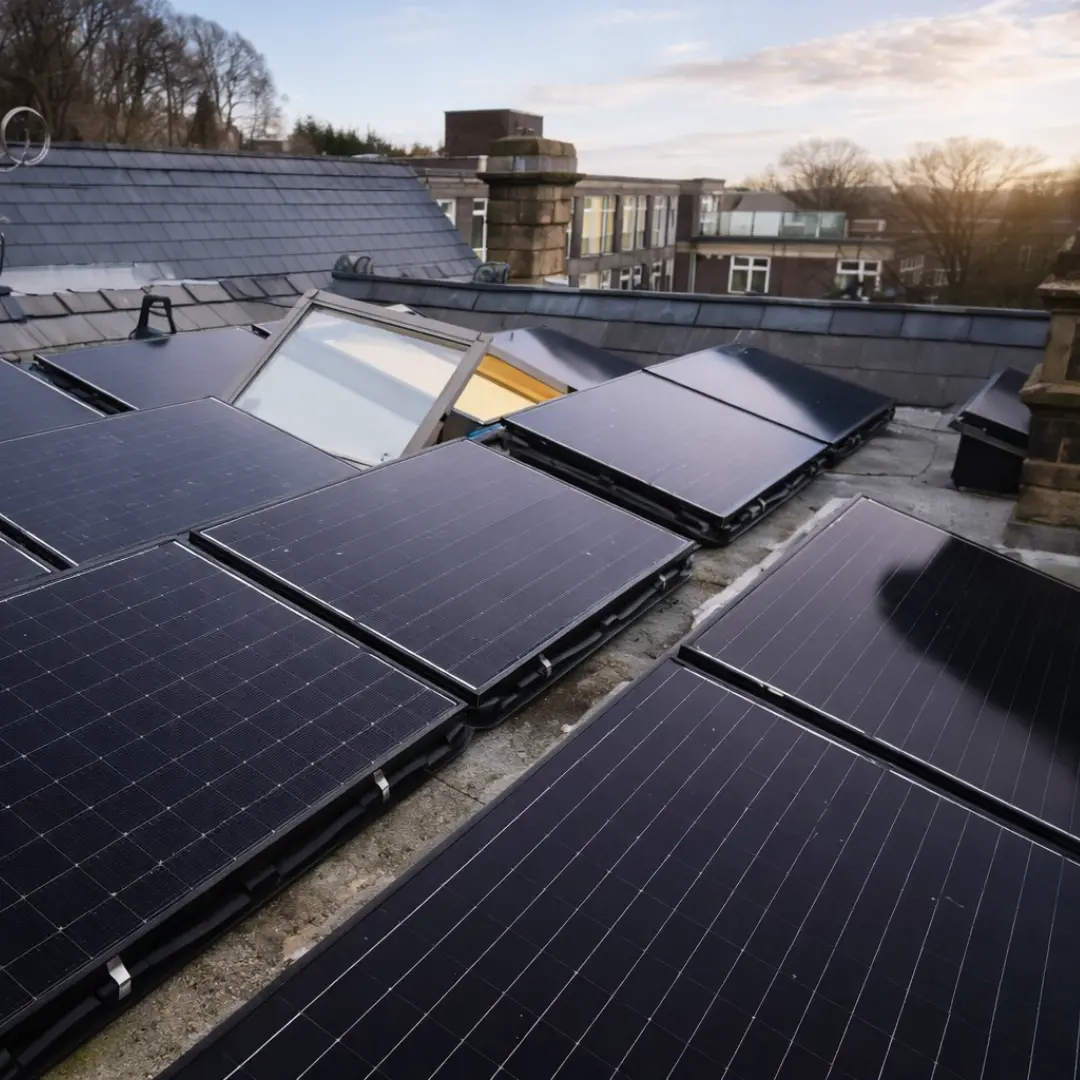
- Roof condition: The roof should be structurally sound, with enough usable space. Damaged or ageing roofs may need repairs before panels can be installed.
- Orientation and shading: South-facing is ideal but not essential. East- and west-facing roofs can still work, while heavy shading may reduce output.
- Flats and leasehold homes: Freeholder consent, roof ownership, lease terms and communal electrical arrangements must be checked.
- Electrical connection: The installer may inspect the consumer unit, earthing, meter and local network requirements. Export limits may apply.
- Electricity use: Homes using more power during daylight hours may benefit more from the electricity generated.
A survey will confirm whether solar is suitable and whether any preparatory work is required.
Frequently asked questions (FAQs)
Clear answers to common questions about free solar panels, EPC requirements, approved installers, batteries, enabling work and Smart Export Guarantee payments. Speak to Simple Green Energy .
Need help checking your eligibility?
Speak with Simple Green Energy to explore available solar-panel funding routes and check whether your household and property may qualify.
Check solar funding eligibilityFinal Thoughts on Solar Panel Grants in 2026
Genuine solar support is available in 2026, but there is no single UK grant that suits every household. Your country, tenure, income, benefits, EPC rating and property condition all affect which route may be available.
It is also important to separate grants from loans, 0% VAT relief and export payments, as each works differently. The safest place to start is an official government, council or scheme eligibility checker.
Even where solar panels are fully funded, the system should still be designed around the roof, electricity use and expected generation—not simply the maximum number of panels available.
Once you know which funding route may apply, the next question is whether solar is technically and financially suitable for your property.