



Energy Company Obligation Scheme (ECO4) 2026
Energy efficiency is still one of the biggest challenges for UK households, especially in homes that lose heat quickly or rely on outdated heating systems. In 2026, ECO4 continues to support eligible properties with targeted insulation, heating and retrofit upgrades.
That is exactly why the Energy Company Obligation Scheme matters.
Instead of only helping households manage higher bills, ECO4 focuses on improving the home itself: reducing heat loss, upgrading inefficient systems and making properties warmer for the long term.
Under ECO4, support is delivered through obligated energy suppliers, but customer contributions may be required depending on the property, measures recommended and funding available. The scheme is currently scheduled to run until 31 December 2026.

Quick answer: What is the Energy Company Obligation Scheme ECO4 in 2026?
The Energy Company Obligation Scheme ECO4 2026 is a government energy-efficiency scheme in Great Britain that places legal obligations on larger energy suppliers to help improve domestic homes. ECO4 is designed to reduce fuel poverty, cut carbon emissions and upgrade some of the least energy-efficient properties. Ofgem confirms that ECO4 runs until 31 December 2026 after a nine-month extension.
For households, ECO4 can support upgrades such as insulation, heating improvements, renewable heating, district heating connections and whole-house retrofit measures. Ofgem describes ECO4 as a scheme focused on homes in EPC bands D to G, with a stronger focus on multi-measure upgrades rather than single improvements.
Table of Contents
ToggleWhy ECO4 matters in 2026
A cold home is not just uncomfortable. It can mean higher bills, wasted energy, damp, mould risk and pressure on households already struggling with rising living costs.
ECO4 exists to tackle that problem at the source. Instead of only helping people pay energy bills, it supports improvements that can make a home warmer and more efficient for years.
The scheme is aimed at households most likely to benefit from energy-saving work, especially those living in lower-rated homes. Ofgem says ECO4 focuses on low-income, fuel-poor and vulnerable households, while also requiring a more complete “fabric first” and whole-house retrofit approach.
Is ECO4 still available in 2026?
Yes. ECO4 has been extended and is scheduled to end on 31 December 2026. The UK Government confirmed the extension so obligated suppliers have additional time to meet targets and manage scheme closure properly.
That means 2026 is an important year for eligible households, landlords, installers and suppliers. Applications, surveys and installations are still possible, but support depends on property eligibility, supplier funding, installer availability and whether the proposed measures meet ECO4 rules.
Customer contributions apply under ECO4
ECO4 is not a simple voucher where every household receives the same amount. The level of support depends on the property, the measure package, the supplier, the installer and the expected energy-saving score.
For this funding route, customer contributions may be required. Ofgem says energy companies decide which retrofit projects they fund, how much support they provide, and that customers may be asked to contribute towards installation costs. Ofgem also encourages households to compare offers before agreeing to work.
Ofgem’s ECO4 delivery guidance also confirms that, from May 2024, operatives must record the financial amount a consumer contributes towards any ECO4 measure in the Customer Contribution field of the TrustMark Retrofit Portal. DESNZ or Ofgem may request evidence of that contribution, such as an invoice, bank statement or other transaction record.
In simple terms: contribution amounts should be clear, documented and agreed before work starts.
Who may qualify for ECO4 in 2026?
You may be considered for ECO4 if your home needs energy-efficiency upgrades and you meet the relevant household or property criteria.
GOV.UK says private households may be eligible if they claim certain benefits and live in private housing, while social housing tenants may also qualify where the property has a low energy-efficiency rating.
Qualifying benefits can include:
| Eligibility route | Examples |
|---|---|
| Means-tested benefits | Universal Credit, Income Support, Housing Benefit |
| Pension support | Pension Guarantee Credit, Pension Savings Credit |
| Employment support | Income-based JSA, income-related ESA |
| Family support | Child Benefit, subject to income rules |
| ECO4 Flex | Low income, health vulnerability, fuel debt or local authority referral |
You may be considered for ECO4 if your home needs energy-efficiency upgrades and you meet the relevant household or property criteria.
GOV.UK says private households may be eligible if they claim certain benefits and live in private housing, while social housing tenants may also qualify where the property has a low energy-efficiency rating.
Qualifying benefits can include:
ECO4 property rules: EPC ratings matter
The property rating is a key part of ECO4.
GOV.UK says owner-occupied homes in private housing generally need an energy-efficiency rating of D, E, F or G, while privately rented homes generally need a rating of E, F or G and landlord permission.
For social housing, GOV.UK says homes rated E, F or G may be eligible for support with insulation or first-time heating system installation.
Ofgem also confirms ECO4 has a Minimum Requirement: starting SAP band D or E homes should be improved to at least band C, while starting SAP band F or G homes should be improved to at least band D.
What home improvements can ECO4 support?
ECO4 is designed around a whole-house retrofit approach. That means the property is assessed first, then a package of suitable measures is recommended.
Common ECO4 measures may include:
| Measure | Why it helps |
|---|---|
| Loft insulation | Reduces heat loss through the roof |
| Cavity wall insulation | Helps keep heat inside external walls |
| Solid wall insulation | Improves older or harder-to-treat homes |
| Room-in-roof insulation | Helps improve converted loft spaces |
| Underfloor insulation | Reduces heat loss through floors |
| First-time central heating | Adds a full central heating system where eligible |
| Heating controls | Improves control over heating use |
| Renewable heating | Supports lower-carbon heating where suitable |
| District heating connection | Connects suitable homes to a heat network |
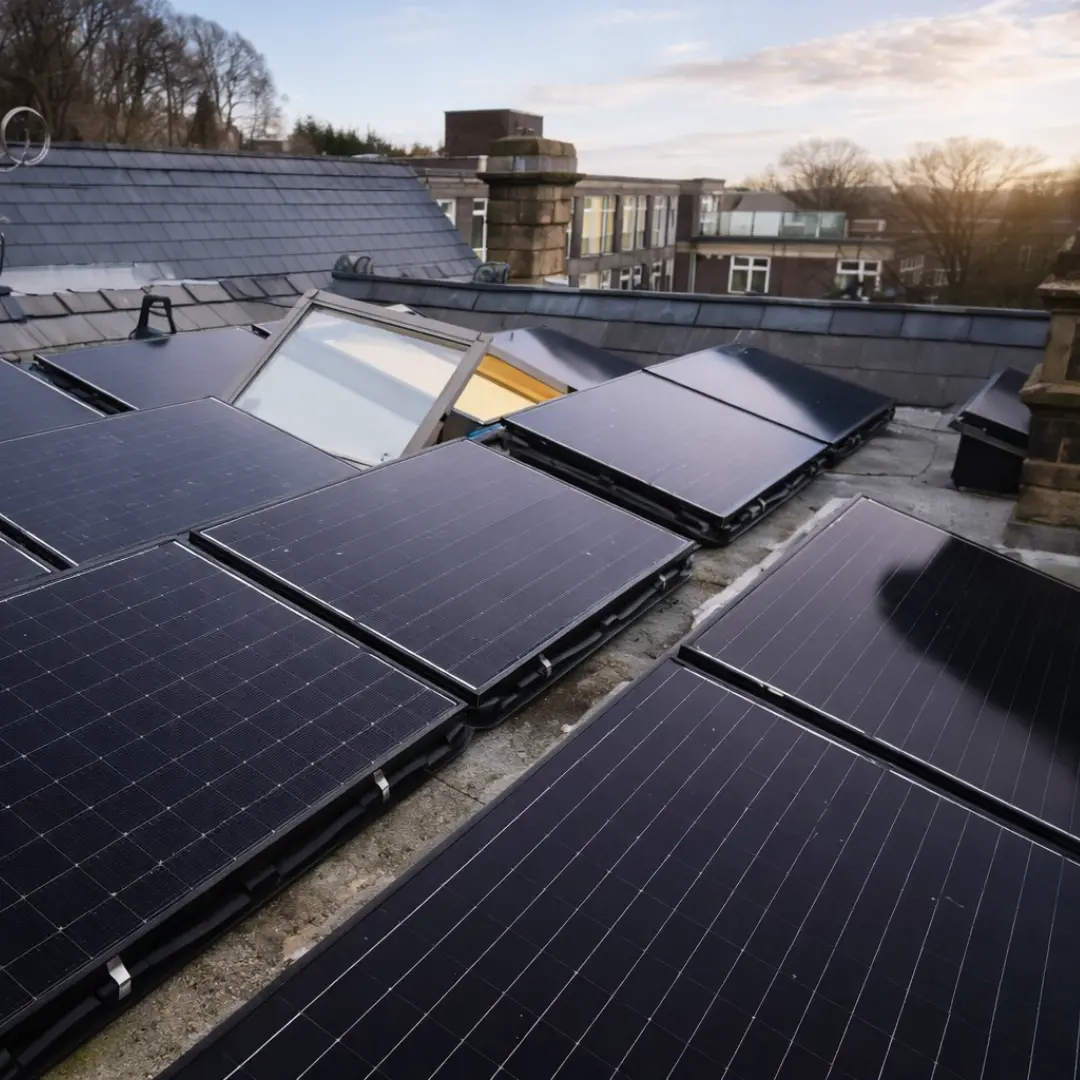
| Solar PV | Can be eligible in specific heating-related ECO4 scenarios |
Ofgem states that ECO4 aims to encourage measures including insulation, first-time central heating, renewable heating and district heating connections.
ECO4 Flex: another route for households
ECO4 Flex allows local authorities, the Scottish Government, the Welsh Government and energy suppliers to refer households that may not receive the standard qualifying benefits but still need support.
Ofgem says ECO4 Flex can apply where a household has a combined gross annual income under £31,000, or where someone in the household has a severe or long-term health condition made worse by living in a cold home. Relevant health categories include cardiovascular conditions, respiratory disease, limited mobility and immunosuppression.
Energy suppliers can also refer households through ECO4 Flex where customers are struggling with persistent fuel debt or regularly unable to stay connected through prepayment meters due to financial hardship.
ECO4 for landlords and private tenants
Tenants can benefit from ECO4, but landlord consent is required before work can go ahead.
Ofgem says privately rented properties occupied by an eligible tenant may receive ECO4 measures if the property has an initial SAP rating of E, F or G. For private rented homes, the measure package must include at least one key qualifying measure such as solid wall insulation, first-time central heating, a district heating connection or renewable heating.
For landlords, ECO4 can help improve the property’s efficiency rating and comfort, but contributions and permissions should be agreed clearly before installation.
How the ECO4 process usually works
A typical ECO4 journey looks like this:
- The household checks eligibility through a supplier, council, installer or advice route.
- A retrofit assessor reviews the property.
- A suitable measure package is proposed.
- The customer contribution is confirmed in writing.
- The customer reviews the contract before agreeing.
- Work is completed by approved professionals.
- Post-installation documents and declarations are provided.
Ofgem says customers should only agree to ECO measures once they have received a contract and should not sign for works they do not consider suitable for their home.
Quality checks and installer standards
ECO4 work should be delivered by properly accredited professionals.
Ofgem says ECO installers must be TrustMark registered businesses, except for certain district heating connections. Households should ask to see registration credentials and can check them through TrustMark.
For most measures, installers must also meet relevant PAS standards. For low-carbon microgeneration measures, Ofgem says installers need Microgeneration Certification Scheme accreditation. Gas boiler work must be carried out by Gas Safe registered companies.
What documents should customers receive?
Before agreeing to ECO4 work, customers should have clear paperwork. This matters even more where a contribution is required. Ofgem says customers should keep documents setting out the works, including a contract, the ECO4 Eligibility Requirements Form, the ECO4 Privacy Notice, and the Post Installation Customer and Installer Declaration. Customers should only sign the post-installation declaration once the work is complete and they are satisfied.
A good ECO4 offer should clearly show:
| Document or detail | Why it matters |
|---|---|
| Written quote | Shows what is included and what the contribution covers |
| Contract | Confirms the agreed work and responsibilities |
| Customer contribution amount | Avoids confusion over payment expectations |
| Installer credentials | Helps verify the company carrying out the work |
| Guarantees or warranties | Supports future protection if problems arise |
| Post-installation declaration | Confirms completion and customer satisfaction |
Can ECO4 be combined with other government funding?
Usually, ECO4 measures cannot be blended with other government funding for the same measure.
Ofgem says funding for measures delivered under ECO4 must not be blended with funding from other government schemes or grants, including Warm Home Discount, the Boiler Upgrade Scheme, Social Housing Decarbonisation Fund and Home Upgrade Grant.
This is why the assessment stage matters. The installer or supplier should explain what is being funded through ECO4, what is outside ECO4, and what contribution is expected from the customer.
How to apply for ECO4 in 2026
You can start by contacting your local council, an obligated energy supplier, or a qualified ECO installer. GOV.UK says households can contact their local council to see whether it is taking part in ECO, or contact an energy supplier directly.
You do not need to be with the same energy supplier that funds the work. Ofgem confirms households can receive help from another obligated energy company while remaining with their current provider.
Before applying, have these ready:
Ofgem says funding for measures delivered under ECO4 must not be blended with funding from other government schemes or grants, including Warm Home Discount, the Boiler Upgrade Scheme, Social Housing Decarbonisation Fund and Home Upgrade Grant.
This is why the assessment stage matters. The installer or supplier should explain what is being funded through ECO4, what is outside ECO4, and what contribution is expected from the customer.
| Information | Why it helps |
|---|---|
| Address | Used to check property records |
| EPC rating | Helps confirm property eligibility |
| Benefit evidence | Supports Help to Heat eligibility |
| Income details | May support ECO4 Flex eligibility |
| Health or vulnerability evidence | May support ECO4 Flex referral |
| Landlord details | Needed for privately rented homes |
| Current heating information | Helps assess suitable measures |
Frequently asked questions (FAQs)
Simple answers to common questions about the Energy Company Obligation scheme ECO4 in 2026, including eligibility, EPC ratings, customer contributions, private tenants, boilers and home energy upgrades. Speak to Simple Green Energy.
Need help checking ECO4 eligibility?
Speak with Simple Green Energy about ECO4 support, home energy upgrades, grant eligibility routes, landlord consent and available insulation or heating measures.
Get ECO4 adviceFinal takeaway
The Energy Company Obligation Scheme ECO4 2026 is still active, but it is not one-size-fits-all.
It can support meaningful home upgrades, especially for lower-rated properties and households facing fuel poverty or vulnerability. But customers should expect a proper assessment, a written offer, clear contribution details and accredited installers.
The best ECO4 applications are simple, transparent and well-documented: check eligibility, confirm the property rating, review the measure package, understand the customer contribution and only sign once everything is clear.