Boiler vs Air Source Heat Pump:
Which Is Better for Your Home?
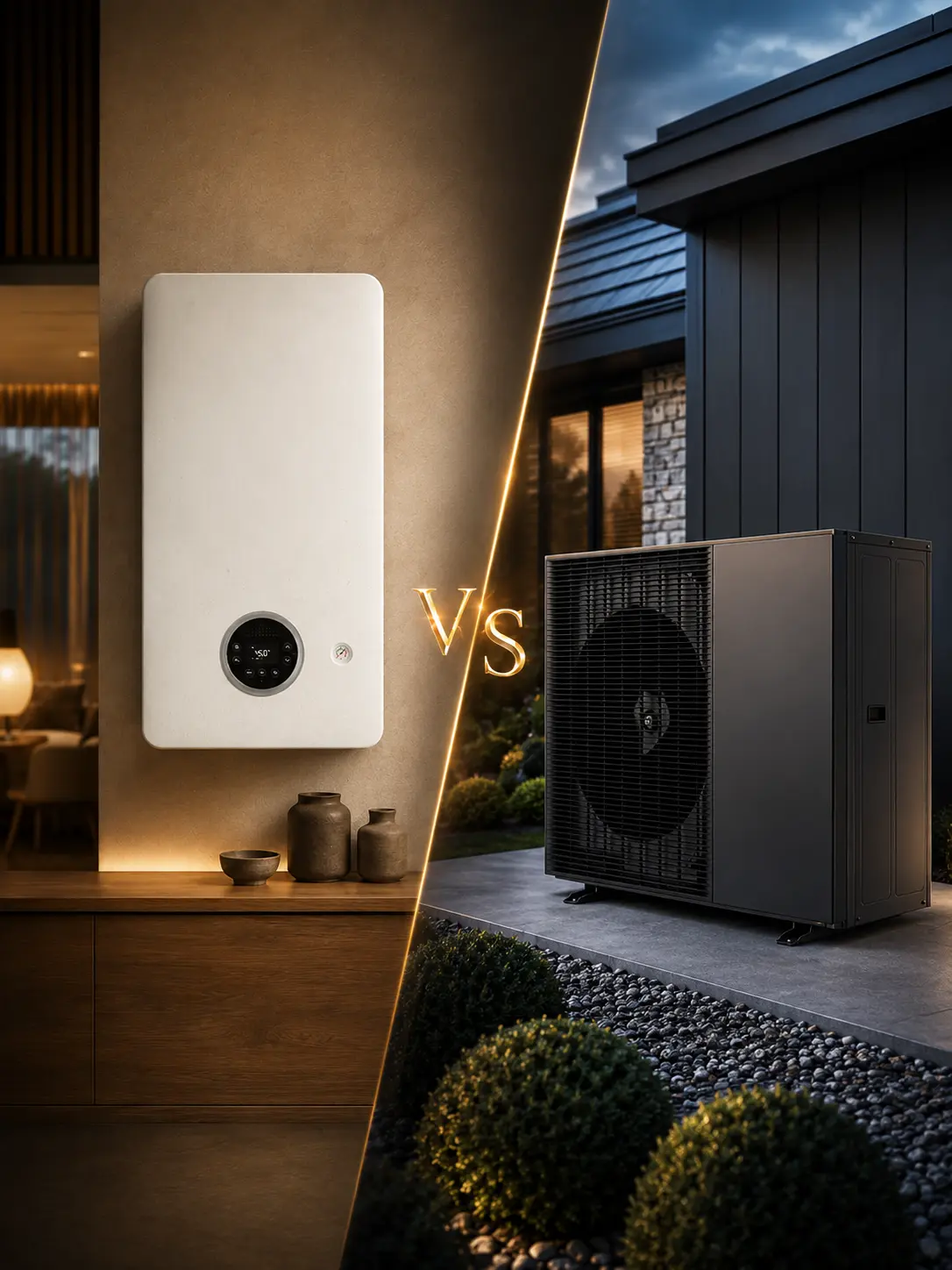
Boilers are still the most common heating system in many UK homes, but air source heat pumps are becoming more popular as homeowners look for efficient, lower-carbon heating. Both systems can heat your home and hot water, but they work in very different ways.
This guide compares boilers and air source heat pumps by efficiency, running costs, installation, suitability, grants, and long-term value, so you can understand which option may be better for your property.
Quick Answer: Boiler or Air Source Heat Pump?
A boiler may be better if you need a quick, lower-cost replacement and your existing heating system is working well. An air source heat pump may be better if your home is suitable, well-insulated, and you want a more efficient, lower-carbon heating system for the long term.
Table of Contents
ToggleGas boiler vs air source heat pump.
Efficiency
Around 85%–94%
Modern Gas Boiler
Burns gas to produce heat, with some energy lost through flue gases and system operation.
Around 300%–400%
Air Source Heat Pump
Uses electricity to move heat from outside air into your home, often delivering 3–4 units of heat for every 1 unit of electricity used.
Running cost
Depends on gas prices
Gas Boiler
Running costs are linked to gas tariffs, boiler efficiency, insulation levels and heating habits.
Can be lower with smart use
Heat Pump
Best performance comes from good design, correct sizing, low-flow temperatures and using smart electricity tariffs where available.
Initial cost
Usually lower upfront
Boiler Installation
A boiler replacement is typically less expensive upfront, especially when the existing heating system is already suitable.
Higher upfront investment
Heat Pump Installation
Installation can cost more because it may include system design, cylinder upgrades, radiator checks and electrical work.
Funding support
Limited support
Gas Boiler
Ofgem ended ECO4 in March 2026, meaning traditional boiler replacement support is now more limited compared with low-carbon heating options.
Up to £7,500 support
Air Source Heat Pump
Eligible homeowners may be able to access support through schemes such as the Boiler Upgrade Scheme, subject to property and scheme criteria.
Carbon impact
Uses fossil fuel
Gas Boiler
Produces carbon emissions on-site because it burns natural gas to heat your home and hot water.
Low-carbon heating
Heat Pump
Runs on electricity and can significantly reduce home heating emissions, especially as the UK electricity grid becomes cleaner.
Heating style
Fast, high-temperature heat
Gas Boiler
Often heats radiators quickly using higher water temperatures, which many homeowners are already familiar with.
Steady, consistent warmth
Heat Pump
Works best by maintaining a comfortable temperature over longer periods using lower flow temperatures.
Maintenance
Annual service recommended
Gas Boiler
Requires regular servicing to check combustion, safety controls, flue condition and overall performance.
Low-maintenance system
Heat Pump
Still needs periodic servicing, but there is no gas combustion, flue or carbon monoxide risk from the heating unit itself.
Lifespan
Around 10–15 years
Gas Boiler
Typical lifespan depends on servicing, usage, water quality and installation quality.
Around 15–20 years
Air Source Heat Pump
Can offer a longer service life when correctly designed, installed and maintained.
Best for
Gas Boiler
Homes looking for a familiar heating system, lower upfront cost and a straightforward replacement where gas heating is already installed.
Air Source Heat Pump
Homeowners wanting a future-ready, efficient, low-carbon heating system with long-term energy and sustainability benefits.
What Is the Main Difference?
The main difference between a boiler and an air source heat pump is how they produce heat for your home. A traditional gas boiler burns fossil fuel to heat water for radiators and hot water, while an air source heat pump uses electricity to extract heat from the outside air and transfer it into your home. This makes heat pumps much more energy efficient, often delivering around three to four units of heat for every unit of electricity used. In comparison, most boilers work at around 85–90% efficiency. For UK homeowners, switching from a boiler to an air source heat pump can help reduce carbon emissions, improve home energy efficiency, and support long-term savings, especially when combined with good insulation and suitable heating controls.
Efficiency and Running Costs
When comparing a boiler vs an air source heat pump, efficiency is one of the biggest differences. A modern gas boiler is usually around 85–90% efficient, meaning some energy is lost during the heating process. An air source heat pump, however, can be around 300–400% efficient because it does not create heat by burning fuel; it transfers heat from the outside air into your home.
This means a heat pump can produce three to four units of heat for every one unit of electricity it uses. Running costs depend on your property size, insulation, heating habits, and current energy prices. Gas is usually cheaper per unit than electricity, but because heat pumps are much more efficient, they can still be cost-effective in the right home. According to Ofgem, the UK energy price cap changes regularly, so actual heating costs can vary over time. For the best results, an air source heat pump should be installed in a well-insulated property with properly sized radiators or underfloor heating. This helps the system run at lower flow temperatures, improving efficiency and reducing long-term running costs.
Which Heating System Is More Suitable for Your Home?
Choosing between a boiler and an air source heat pump depends on your property’s insulation, heating setup, budget, and long-term energy goals. Both systems can heat your home effectively, but they work best in different situations. A boiler may suit homes that need a straightforward replacement, while an air source heat pump may be better for homeowners looking for a more efficient, low-carbon heating solution.
A Boiler May Be Better If
A boiler may be more suitable if your home is already connected to the gas grid and you are looking for a familiar heating system with a lower upfront installation cost. It can be a practical option for properties with existing radiators, standard pipework, and a heating setup that does not require major changes. Boilers are also commonly chosen by homeowners who want fast hot water and a simple like-for-like replacement.
An Air Source Heat Pump May Be Better If
An air source heat pump may be more suitable if your home is well insulated and you want a more energy-efficient heating system. Heat pumps work best when the property can retain heat properly and when the heating system is designed to run at lower temperatures, such as with larger radiators or underfloor heating. They can be a strong option for homeowners who want to reduce carbon emissions, improve energy efficiency, and make their home more future-ready.
Pros and Cons
| Air Source Heat Pump | Gas Boiler | |
|---|---|---|
| Pros |
|
|
| Cons |
|
|
Can You Replace a Boiler with an Air Source Heat Pump?
Yes, you can replace a gas boiler with an air source heat pump, but it’s not always a straight swap. A boiler burns gas to create high-temperature heat, while an air source heat pump works differently by taking heat from the outside air and moving it into your home.
Because of this, your property needs to be checked properly before making the switch.
The good news is that many UK homes can be suitable for an air source heat pump, especially if they have good insulation and the right heating setup. In some cases, your home may need a few upgrades first, such as larger radiators, improved insulation, upgraded pipework, or a hot water cylinder.
These improvements help the heat pump run more efficiently and keep your home warm without wasting energy.
Replacing your boiler with an air source heat pump can be a smart long-term move if you want a more efficient, low-carbon, future-ready heating system. The key is getting the design right from the start. A professional home survey can confirm whether your property is suitable and show exactly what is needed to make the switch work properly.
Common Mistakes to Avoid
When comparing a boiler vs an air source heat pump, it is easy to focus only on price or installation time. However, choosing the right heating system depends on your home’s insulation, heating design, long-term running costs, and energy goals. Avoid these common mistakes before making your decision.
Comparing Only the Upfront Cost
A gas boiler usually has a lower installation cost than an air source heat pump, but upfront price should not be the only factor. Heat pumps can offer much higher efficiency, lower carbon emissions, and longer-term energy benefits. Always compare the full picture, including installation cost, running cost, lifespan, maintenance, and available grant support.
Ignoring Insulation
Insulation plays a major role in how well your heating system performs. An air source heat pump works best in a home that can retain heat properly. If your property has poor loft insulation, cavity wall issues, draughts, or heat loss, the system may need to work harder. Improving insulation first can help reduce energy waste and improve comfort. on price or installation time. However, choosing the right heating system depends on your home’s insulation, heating design, long-term running costs, and energy goals. Avoid these common mistakes before making your decision.
Expecting a Heat Pump to Work Like a Boiler
A heat pump heats your home differently from a boiler. Boilers usually deliver higher-temperature heat quickly, while heat pumps work more efficiently at lower temperatures over a longer period. This does not mean they are weaker — it means the system needs to be designed and used correctly for steady, efficient heating.
Choosing an Installer Without Proper Design
A successful heat pump installation depends on correct sizing, heat loss calculations, radiator checks, pipework assessment, and hot water planning. Choosing an installer without proper design can lead to poor performance, higher running costs, or an uncomfortable home. Always make sure your property is assessed properly before installation.
Frequently asked questions (FAQs)
Answers to the most searched questions about boilers and air source heat pumps, including efficiency, running costs, installation, radiators, cold weather performance, carbon emissions, and which heating system may be best for your home. Speak to Simple Green Energy.
Need help choosing?
Speak with Simple Green Energy to check whether a boiler or air source heat pump is more suitable for your property, insulation, radiators, hot water needs, and long-term energy goals.
Get heating adviceFinal Thoughts
Choosing between a boiler and an air source heat pump is not just about replacing one heating system with another, it is about choosing how your home will be heated for the next 10 to 20 years.
A gas boiler may feel like the easier option because it is familiar, quick to install, and often cheaper upfront. But an air source heat pump takes a different approach. It focuses on efficiency, lower carbon heating, and long-term performance rather than simply producing heat as quickly as possible.
The best choice comes down to your home. If your property is well insulated, has the right heating setup, and you are thinking long term, an air source heat pump can be a strong future-ready investment. If your home needs a simple replacement with minimal changes, a boiler may still be a practical short-term solution.
Before deciding, look beyond the installation cost. Consider efficiency, running costs, lifespan, carbon impact, available funding, and how suitable your property is. A professional home assessment can help you make the right decision with confidence.