All-Black vs Standard Solar Panels: Appearance vs Performance for UK Homes
All-black solar panels usually look better on residential roofs, while standard panels can sometimes offer slightly better value or marginal optical advantages. However, colour alone does not determine which panel will generate more electricity.
Modern all-black modules can combine a premium appearance with excellent efficiency, temperature performance and long warranties. Equally, a standard panel with black cells, a silver frame and white backing may provide comparable output at a lower installed price.
The right choice depends on your roof space, budget, electricity use and how visible the installation will be. This guide compares appearance, performance, cost, warranties and long-term value so UK homeowners can make an informed decision.
Get Your Solar Panel Quote
Start with your address so we can check the best solar options for your home.
Quick answer
All-black solar panels are normally best for homeowners who want a discreet, uniform installation, particularly on slate, dark tiles or prominent front-facing roofs. Standard panels are often better for value-focused installations where appearance is less important. A reflective white backsheet can return some light towards the solar cells, but this does not automatically make every standard panel more efficient. Cell technology, panel wattage, dimensions, temperature coefficient, shading and installation quality matter more than colour. The best option is therefore the panel that delivers the highest suitable system capacity, annual generation and warranty protection for your roof and budget.
Table of Contents
ToggleAll-black vs standard solar panels: quick comparison
| Factor | All-black solar panels | Standard solar panels |
|---|---|---|
| Appearance | Uniform black cells, frame and backing | Usually black cells with a silver frame or visible white areas |
| Best suited to | Visible roofs, dark tiles, modern homes and premium renovations | Rear roofs, rental properties, outbuildings and value-led projects |
| Efficiency | Can be exceptionally high with modern technology | Can be equally efficient; reflective backing may provide a small optical benefit |
| Heat performance | Depends on cell technology and temperature coefficient | A white-backed equivalent may absorb slightly less heat |
| Roof-space value | Excellent when using high-wattage, high-efficiency models | Depends on wattage, efficiency and physical dimensions |
| Typical price | May carry a modest premium | Often offers the lowest cost per installed watt |
| Main advantage | Cleaner, more integrated appearance | Strong performance and value |
| Main consideration | Do not pay more for colour without comparing specifications | The finished array may be more visible |
What are all-black solar panels?
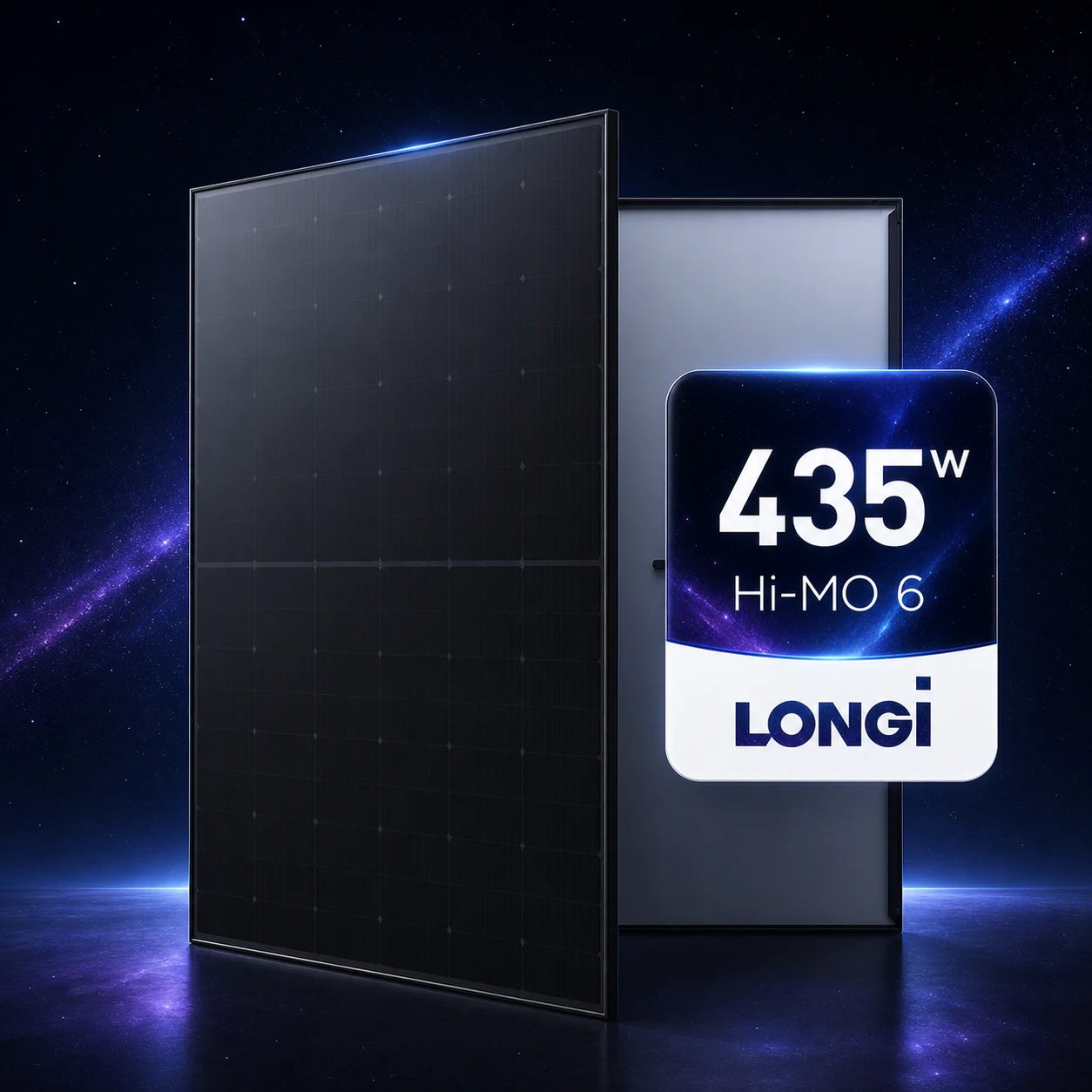
An all-black solar panel normally uses black monocrystalline cells, a black frame and dark material behind or between the cells. Some models also use back-contact technology, which moves electrical contacts away from the front and creates a cleaner surface without prominent silver lines.
Best for
All-black panels are particularly suitable for:
- Slate and dark-tiled roofs
- Front-facing or highly visible roof slopes
- Modern extensions and new-build homes
- Homeowners concerned about kerb appeal
- Properties where the array forms a major part of the roof’s appearance
Key advantages
Their main benefit is visual consistency. When installed with black rails, clamps and carefully planned cable routes, the array can appear as one continuous dark surface rather than a collection of individual panels.
Choosing an all-black finish does not mean accepting poor performance. Current all-black residential products can exceed 24% module efficiency, demonstrating that advanced cell technology can outweigh the optical disadvantages associated with darker backing materials.
Things to consider
“All-black” is an appearance description, not a quality standard. Two panels that look almost identical may have different wattages, dimensions, degradation rates and warranties.
Some products are marketed as all-black even though only the frame is black. Ask to see a photograph and the exact manufacturer datasheet before agreeing to an installation.
What are standard solar panels?
A standard modern solar panel is often still monocrystalline and predominantly black. The visible differences may be a silver aluminium frame, white backing between the cells or a more obvious grid pattern across the front.
Standard panels should not be confused with older blue polycrystalline modules. Many standard-looking panels use current N-type, TOPCon or back-contact technology and can provide excellent residential performance.
Best for
Standard panels may be the sensible choice for:
- Rear roofs that cannot be seen from the road
- Garages and outbuildings
- Landlords and property investors
- Commercial premises
- Buyers prioritising cost per watt
- Large roofs where space is not restricted
Key advantages
White material behind the cells can reflect some light that would otherwise be absorbed. Fraunhofer ISE research found a 1.47% internal reflection gain from a white polymer backsheet compared with a fully absorbing rear surface in its module simulation. That figure describes an optical effect—not a guaranteed 1.47% increase in household generation—but it explains why white-backed versions can sometimes have a slightly higher rating than equivalent black-backed products.
Which type looks better?
All-black panels generally produce the most discreet result. They blend particularly well with dark slate and concrete tiles, while silver frames and white cell gaps create more contrast.
Appearance is subjective, however. A symmetrical standard-panel layout can look better than an all-black system that has been squeezed around roof windows, vents or chimneys.
The mounting equipment matters too. Ask your installer about:
- Black mounting rails and end caps
- Black clamps
- Cable concealment
- Consistent panel orientation
- Equal spacing around roof edges
- Landscape versus portrait layouts
- In-roof systems where appropriate
Visual recommendation: Add a side-by-side roof mock-up showing both finishes on the customer’s actual property.
Planning permission is not normally required for domestic rooftop solar, although additional restrictions can apply to listed buildings, conservation areas and certain protected locations. Homeowners should check with their local planning authority when restrictions may apply.
Do all-black panels perform worse?
Not automatically. The finish is only one part of the panel.
Efficiency and wattage
Efficiency measures how much of the sunlight landing on the panel is converted into electricity. Wattage is the panel’s rated output under standard test conditions.
A higher-efficiency panel can produce more power from a limited roof area, but physical size must also be considered. A 475W panel is not necessarily better for your home if its dimensions prevent an additional panel from fitting.
Compare the total capacity that can be installed—not merely the wattage of one module.
Temperature performance
Solar-panel output falls as cell temperature increases. The power temperature coefficient shows how quickly this happens and is expressed as a percentage per degree Celsius.
A figure closer to zero is preferable. For example, a panel rated at −0.26%/°C loses less power as temperatures rise than one rated at −0.35%/°C under the same conditions. Current all-black panels are available with coefficients around −0.26%/°C, so a dark finish does not necessarily mean weak thermal performance.
UK winter and cloudy weather
Both types continue generating in cloudy conditions because photovoltaic cells use light rather than heat. Winter production is lower mainly because daylight hours are shorter and solar irradiance is weaker—not because the panels are black or standard.
Roof direction and shading will normally create a much greater difference than panel colour. Energy Saving Trust estimates that east- or west-facing roofs typically generate around 15–20% less than equivalent directly south-facing roofs.
Which option is best for your home?
| Buyer, property or cost factor | Recommended approach | Reason |
|---|---|---|
| Prominent front-facing roof | All-black | Provides a cleaner, less contrasting appearance |
| Slate or dark-tiled property | All-black | Usually blends more naturally with the roof covering |
| Rear roof or outbuilding | Best-value specification | Paying more for appearance may provide little benefit |
| Limited roof area | Highest suitable power density | Total installed capacity matters more than finish |
| Landlord or property investor | Standard or competitively priced all-black | Prioritise reliability, warranty and return on investment |
| Family with an EV or heat pump | Highest practical system capacity | Future electricity demand should guide the design |
| Typical 4.5kWp domestic system | Approximately £7,600 | Current UK benchmark before optional battery storage |
| Battery storage | Commonly £5,000–£8,000 | Requires separate savings and usage modelling |
The cost figures are national benchmarks rather than quotations. Energy Saving Trust currently estimates that a typical 4.5kWp domestic system uses around 12 panels, occupies approximately 20–30m² and costs about £7,600.
How to compare all-black and standard panels
1. Establish how many panels fit
Your installer should measure the usable roof area and account for chimneys, windows, vents, shading and suitable distances from roof edges.
2. Compare total system capacity
Do not choose based on panel wattage alone. Compare the total kilowatt-peak capacity each proposed layout can achieve.
3. Review predicted annual generation
Ask for a property-specific generation estimate showing roof direction, pitch, local irradiance and shading assumptions.
4. Check the temperature coefficient
This helps indicate how well the module retains power as cell temperature rises. Compare the same measurement across every shortlisted product.
5. Examine degradation guarantees
Solar panels gradually produce less electricity as they age. Compare the first-year degradation allowance, annual degradation and guaranteed output at the end of the warranty.
6. Understand the warranties
Check the product warranty, performance warranty and installation workmanship guarantee. Establish who handles a claim and whether labour, scaffolding and replacement transport are covered.
7. Compare the complete installation
The cheapest panel does not necessarily produce the cheapest or best system. Compare:
- Inverter specification
- Mounting equipment
- Monitoring
- Scaffolding
- Electrical upgrades
- Bird protection
- Distribution Network Operator applications
- Workmanship cover
- Aftercare
Energy Saving Trust recommends obtaining quotations from at least three MCS-certified installers. MCS certification may also be required when applying for certain export tariffs.
UK costs, savings and payback
An all-black finish may be included as standard or may carry a premium, depending on the manufacturer, panel technology and installer’s normal stock. Ask for an itemised comparison using the same inverter, mounting system, scaffolding and warranty cover.
Installation cost is also affected by:
- System size
- Roof access and scaffolding
- Roof condition
- Number of roof slopes
- Electrical work
- Inverter location
- Optimisers
- Battery storage
- Bird protection
- In-roof rather than on-roof mounting
Savings depend on annual generation, electricity prices, household consumption and how much solar electricity is used in the property.
Surplus electricity can be exported through the Smart Export Guarantee in England, Scotland and Wales, provided the system and metering meet the relevant eligibility requirements. Suppliers set their own export tariffs.
Energy Saving Trust’s July 2026 examples indicate payback periods of approximately nine years in London and up to 12 years in Stirling, depending on location and occupancy pattern. These are illustrative figures, not guaranteed returns.
A property survey and personalised generation forecast are required for an accurate quotation.
Why the installer matters more than the colour
A high-quality panel cannot correct poor system design.
Incorrect roof fixings, avoidable shading, unsuitable inverter sizing, excessive voltage drop or weak cable management can reduce performance and create long-term reliability problems.
The current MCS installation standard requires a suitably competent person to check that the roof can withstand the loads imposed by the solar system. A structural engineer should be consulted where the roof is unusual, has signs of distress or creates uncertainty. Systems must also be commissioned through a documented process to confirm that they are safe and operating in accordance with the design.
A trustworthy installer should provide:
- An exact panel datasheet
- A roof layout
- A realistic generation estimate
- Written savings assumptions
- Warranty documentation
- Electrical certification
- Commissioning records
- Monitoring instructions
- Clear aftercare arrangements
- Photographs of comparable installations
Are all-black panels worth paying more for?
They can be when the array is highly visible and the premium is reasonable. Solar panels may remain on the roof for decades, so homeowners renovating a premium property may value the cleaner finish throughout that period.
The premium becomes harder to justify on a rear roof, commercial building or outbuilding where the panels are rarely seen.
The strongest approach is to request two otherwise comparable quotations. Calculate the additional cost of the all-black finish and check whether it changes the system’s capacity, estimated generation or warranty.
Can batteries be added later?
Usually, although the system should be designed with future expansion in mind.
Ask whether the proposed battery would be AC-coupled or DC-coupled, whether the inverter is battery-ready and whether additional equipment would be required. The visual finish of the panels has no meaningful effect on battery compatibility.
Frequently asked questions (FAQs)
Clear answers about all-black solar-panel appearance, efficiency, pricing, temperature, slate roofs, winter performance and lifespan. Speak to Simple Green Energy .
Considering all-black solar panels?
Speak with Simple Green Energy about panel appearance, roof finish, efficiency, dimensions, system capacity, warranties and whether an all-black module suits your property.
Compare my panel optionsConclusion: appearance or performance?
All-black solar panels are usually the better choice for a visible residential roof, especially where slate, dark tiles or architectural appearance are important.
Standard panels can provide better value where the roof is hidden or there is little benefit in paying for a uniform finish. A reflective white backsheet may offer a small optical advantage, but panel technology, efficiency, temperature coefficient, dimensions and roof layout are more important than colour alone.
Compare complete systems rather than isolated panel specifications. The right installation should balance appearance, annual generation, warranty support and lifetime value.
Book a free Simple Green Energy home survey to compare roof layouts, system capacity, appearance and estimated savings before choosing your panels.