


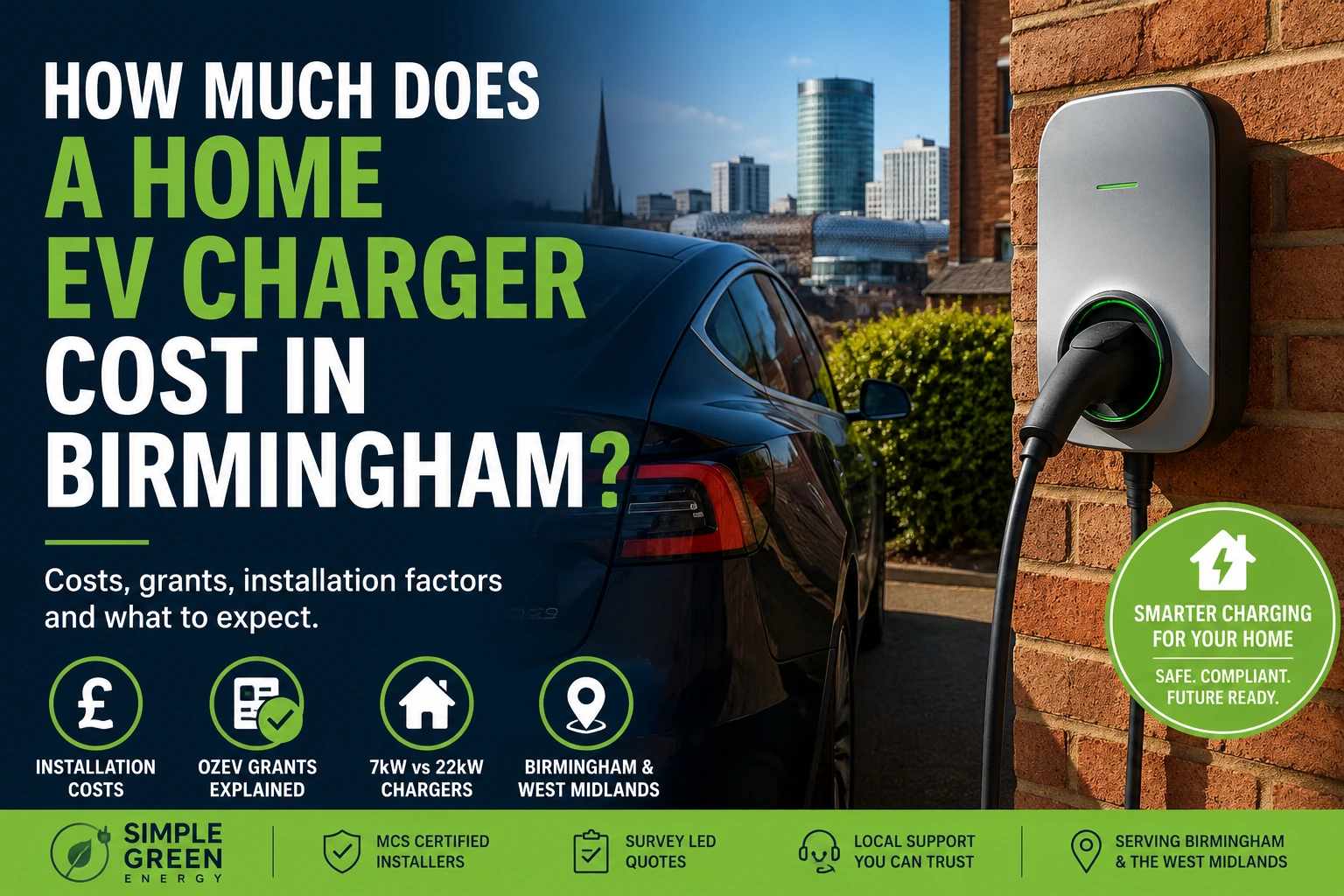
How Much Does a Home EV Charger Cost in Birmingham?
If you are asking how much does a home EV charger cost in Birmingham?, the honest answer is that it depends on your property, charger choice and electrical setup. A home charger is often cheaper, faster and more convenient than relying on public charging, especially if you can charge overnight on a suitable tariff, but the installation price can vary. A simple driveway installation in Hall Green or Sutton Coldfield may be very different from a flat in Birmingham city centre, a terraced house in Moseley, or a rental property with shared parking. The final cost depends on the charger type, cable route, consumer unit, earthing arrangement, parking layout and whether you qualify for an OZEV grant.
Get your free EV charger quote
Secure, GDPR-protected EV charger enquiry.
Find your property
No spam. No third-party sharing.
Choose your EV charger brand
Contact details
Your details stay private and protected.
Thank you
Your request has been received. Our team will contact you shortly.
Quick Answer: How Much Does a Home EV Charger Cost in Birmingham?
A typical 7kW smart home EV charger installation in Birmingham often costs around £800–£1,400 for a straightforward domestic installation, including the charger and standard installation work. More complex jobs can rise to £1,500–£2,500+, especially where there are long cable runs, consumer unit upgrades, trenching, flats, shared parking or electrical remedial works. UK cost guides commonly place standard 7kW installations around the £800–£1,300 range, but every property needs an installation assessment before a firm quote is given.
For an accurate price, Simple Green Energy Ltd can assess your charger location, parking area and consumer unit before providing a clear, survey-led quote.
Table of Contents
ToggleAverage Home EV Charger Cost in Birmingham
Home EV charger prices in Birmingham are not fixed because every property is slightly different. The same charger could be simple to install at a newer home in Longbridge, but more complex at a Victorian terrace in Kings Heath or a leasehold apartment in the Jewellery Quarter.
The table below gives realistic guide ranges for home EV charger cost Birmingham searches. These are not guaranteed prices, but they show how installation complexity affects the final quote.
| Installation Type | Typical Cost Range | What’s Usually Included | When This Applies |
|---|---|---|---|
| Simple home installation | £800–£1,100 | 7kW smart charger, short cable run, standard protective devices, testing, certification and handover | Driveway close to consumer unit, modern electrics, simple wall mounting |
| Standard home installation | £1,000–£1,400 | Charger supply, labour, normal cable route, electrical checks, DNO notification and app setup | Most Birmingham homes with private off-street parking |
| Complex home installation | £1,400–£2,500+ | Longer cable run, extra containment, possible consumer unit work, load management or remedial electrical work | Terraces, detached garages, difficult routes, older electrics or unusual parking layouts |
| Flats, apartments or shared parking | £1,500–£4,000+ depending on design | Charger, permissions, longer cable routes, possible load management and shared-area considerations | Flats in Birmingham city centre, Digbeth, Edgbaston or the Jewellery Quarter |
| Landlord or multi-point installation | Project-specific | Multiple chargers, infrastructure planning, grant checks, load calculations, resident or tenant parking design | Landlords, HMOs, blocks of flats, property managers and residential developments |
The final price can change because of VAT treatment, charger brand, cable length, groundwork, consumer unit condition, earthing, PEN fault protection, Wi-Fi strength and whether extra electrical work is required. A proper quote should follow a site assessment or remote installation assessment, not a guess.
What Affects the Cost of EV Charger Installation?
The cost of EV charger installation Birmingham projects depends on both the product and the property. A reliable installer should ask about your EV, parking space, consumer unit, Wi-Fi signal, cable route and whether the property is owned, rented or leasehold.
| Cost Factor | Why It Matters | Possible Impact on Price |
|---|---|---|
| Charger brand and model | Premium chargers may include better apps, solar integration, load balancing or longer warranties | Higher charger supply cost |
| 7kW vs 22kW charger | 22kW charging usually needs three-phase supply, which most homes do not have | 22kW can cost more and may need extra approval or upgrades |
| Tethered vs untethered | Tethered chargers include a fixed cable; untethered chargers use your own cable | Tethered models are often slightly more expensive |
| Cable run length | Longer cable runs need more cable, labour and containment | Can increase labour and material cost |
| Consumer unit location | A consumer unit close to the driveway is usually easier than one at the back of the house | Longer routes can increase cost |
| Driveway, garage or detached garage | Detached garages and side routes can need extra cabling, protection or trenching | Can move a job from standard to complex |
| Existing electrical condition | Older wiring or overloaded circuits may need attention first | Possible remedial works |
| Consumer unit upgrades | Some homes need additional protection or a new consumer unit section | Adds material and labour cost |
| Earthing and PEN fault protection | EV chargers must be installed safely for the property’s earthing arrangement | May require specific charger features or extra equipment |
| Groundworks or trenching | Running cable underground takes more time and preparation | Can significantly increase cost |
| Wi-Fi or signal issues | Smart chargers need reliable connectivity for app control and smart features | May need signal boosters or alternative connectivity |
| Load management | Helps prevent the home’s electrical supply being overloaded | Adds equipment or setup time |
| Permissions | Flats, rentals and shared parking often need landlord, freeholder or managing agent approval | Can add time and planning work before installation |
Smart chargers sold for private domestic or workplace use in Great Britain are regulated to include smart functionality, helping charging take place when there is lower demand on the grid or more renewable electricity available.
Why Birmingham Homes Can Vary in Installation Cost
Birmingham has a wide mix of homes, and that is one of the biggest reasons EV charger prices vary.
In older Victorian terraces around Moseley, Kings Heath, Balsall Heath, Harborne and Edgbaston, the consumer unit may be away from the parking area, cable routes can be awkward, and off-street parking may be limited. A charger on a front wall may be simple if there is a private driveway, but it becomes more complicated where parking is on-street or shared.
In many 1930s semis around Sutton Coldfield, Hall Green, Yardley, Great Barr and Solihull, installations are often more straightforward when the driveway is next to the house and the consumer unit is accessible. However, older consumer units, long side routes or detached garages can still affect the quote.
Newer homes in Longbridge, Selly Oak and surrounding developments may already have better electrical provision, but the installer still needs to check supply capacity, earthing, cable routes and charger location.
Flats and apartments in Birmingham city centre, Digbeth, the Jewellery Quarter and Edgbaston can be more complex because parking may be allocated, underground, gated or shared. Leasehold rules, managing agent approval, fire routes, cable containment and load management all matter.
For rental properties, HMOs and landlord portfolios across Birmingham and the wider West Midlands, the installation may need more planning because the charger must suit the property, tenant use, ownership permissions and grant eligibility.
How Much Does a 7kW EV Charger Cost?
A 7kW EV charger cost Birmingham quote will usually sit within the most common domestic installation range because 7kW is the practical standard for most UK homes with single-phase electricity.
A 7kW smart charger is normally suitable for overnight home charging. In practical terms, a 7kW to 7.4kW charger can often add roughly 20–30 miles of range per hour, depending on the vehicle, battery size and efficiency.
For many families, that means plugging in during the evening and waking up with enough charge for commuting, school runs, shopping and local journeys around Birmingham, Solihull or the Black Country. The exact charging speed still depends on:
- the car’s onboard charger
- the battery size
- the battery’s state of charge
- the charger output
- the home’s available electrical capacity
- smart charging settings or load management
A 7kW smart home wallbox is usually enough for homeowners who can charge overnight, especially when paired with a suitable EV tariff or solar PV system.
Does a 22kW Charger Cost More?
A 22kW charger can cost more than a standard 7kW charger, but the bigger issue is whether your property and vehicle can actually use it.
Most Birmingham homes have a single-phase electricity supply, which normally supports 7kW home charging rather than 22kW. A 22kW charger usually needs three-phase supply. If your home does not already have three-phase electricity, upgrading the supply can be expensive and may require approval from the network operator.
A 22kW charger also does not automatically mean faster charging for every car. Some EVs cannot accept 22kW AC charging, so the charger may be limited by the vehicle’s onboard charger. For most Birmingham homeowners, a 7kW smart charger is the sensible and cost-effective choice.
A 22kW charger may be worth discussing for:
- larger homes with three-phase supply
- small commercial sites
- landlords planning multiple charging points
- properties with multiple EVs
- workplaces or fleet parking areas
For a normal driveway installation, the best first step is to check the electrical supply before paying extra for a charger speed you may not be able to use.
Are EV Charger Grants Available in Birmingham?
Yes, some EV charger grants are available in Birmingham, but eligibility depends on the applicant and property type.
As of July 2026, GOV.UK states that OZEV home and workplace chargepoint grant schemes have been extended for a final year, with five schemes available until 31 March 2027 and updated grant rates from 1 April 2026.
OZEV EV Chargepoint Grant for Renters and Flat Owners
The EV charger grant for renters and flats can provide 75% off the cost of buying and installing a socket, up to a maximum of £500. It applies to eligible people who either own and live in a flat or rent and live in a residential property, provided they have an eligible vehicle and private off-street parking.
Standard homeowners who own a house with a driveway are not usually eligible under this same renters and flat owners route. GOV.UK specifically lists people who cannot apply, including those who live in a house they own, unless another eligible route applies.
Landlord EV Charger Grants
Residential landlords can apply for support towards chargepoint sockets at residential properties. The landlord grant can cover 75% of buying and installing chargepoints, up to £500 per socket, with grants available for up to 200 sockets per year, subject to eligibility.
This can be useful for landlords, property managers, HMOs, apartment blocks and rental portfolios across Birmingham, West Bromwich, Walsall, Wolverhampton, Dudley, Halesowen and Coventry.
Workplace Charging Scheme
For eligible workplaces, the Workplace Charging Scheme provides up to £500 per socket for installations completed from 1 April 2026, with grants available for up to 40 sockets across all sites.
Grant rules can change, so eligibility should always be checked before booking. The charger must not normally be installed before OZEV confirms eligibility where the grant route requires pre-approval.
Do I Need Permission to Install a Home EV Charger?
For a homeowner with a private driveway, the route is usually simpler. The installer will still need to complete electrical checks, install the charger safely and deal with DNO notification or application requirements.
Birmingham and much of the wider West Midlands sit within National Grid Electricity Distribution territory. National Grid states that its connections service covers the Midlands, South West and Wales, and its domestic EV page allows users to apply to connect an EV charge point or notify an existing EV charge point installation.
You may need additional permission if you live in:
- a rented home
- a flat or apartment
- a leasehold property
- a building with shared parking
- an HMO
- a listed building
- a conservation area
- a property with allocated parking away from the building
Flats, apartments and shared parking may need landlord, freeholder or managing agent approval before any cable routes, drilling, containment or charger locations are agreed. A good installer should help you understand what information is needed before work starts.
What’s Included in a Proper EV Charger Quote?
A proper electric car charger installation Birmingham quote should be clear, itemised and specific to your property. It should not just say “EV charger installed” with no explanation.
| Quote Item | Why It Matters | Question to Ask the Installer |
|---|---|---|
| Charger supply | Confirms the exact brand, model and output | Which charger model is included? |
| Installation labour | Shows what work is included in the price | Is this a standard or complex installation? |
| Cable length allowance | Long cable runs can change the cost | How many metres of cable are included? |
| Protective devices | Essential for safe electrical installation | What protection is being installed? |
| Earthing and PEN protection | Important for EV charging safety | Does the charger include PEN fault protection? |
| Electrical testing | Confirms the installation is safe | Will testing be completed before handover? |
| Certification | Provides proof of compliant electrical work | What paperwork will I receive? |
| DNO notification or application | Helps ensure the local network is informed | Will you handle the DNO process? |
| App setup or handover | Helps the customer use smart features | Will you show me how to use the charger? |
| Warranty details | Clarifies support if something goes wrong | What warranty applies to the charger and workmanship? |
| Exclusions | Avoids surprise extras | Are trenching, consumer unit upgrades or extra groundwork excluded? |
A transparent quote should explain what is included, what is not included and what could change after a site assessment.
Cheap EV Charger Installation: What to Watch Out For
A cheap EV charger quote can look attractive, but the lowest price is not always the safest or best-value option. EV charging involves a high electrical load, so the installation needs to be designed and tested properly.
Watch out for:
- no written quote
- no charger model listed
- no electrical certification
- no clear warranty
- no DNO notification
- no discussion of earthing or load capacity
- pressure to pay cash
- no site assessment or photos requested
- vague “standard install” wording
- no aftercare or app setup support
A good Birmingham EV charger installer should be willing to explain the specification, the cable route, the electrical protection, any limitations and what happens after installation.
How Long Does Installation Take?
Many straightforward home EV charger installations can be completed in around half a day. This is common where the charger is close to the consumer unit, the electrical supply is suitable and the cable route is simple.
More complex installations may take longer. Extra time may be needed for:
- long cable runs
- detached garages
- drilling through thicker walls
- consumer unit upgrades
- groundwork or trenching
- flats or shared parking
- landlord or managing agent approvals
- DNO approval before installation
- load management setup
After installation, the customer should receive a handover, app guidance where relevant, test results, certification and confirmation of any DNO paperwork handled by the installer.
Can Solar Panels Help Reduce EV Charging Costs?
Yes, solar panels can help reduce reliance on grid electricity for EV charging, but the benefit depends on how and when you charge.
If your EV is parked at home during the day, a smart charger can help use surplus solar generation when the panels are producing electricity. If you are usually out during daylight hours, battery storage may help store some daytime solar generation for evening use, although this needs to be designed properly.
Solar PV can be especially useful for households with:
- high daytime electricity usage
- more than one EV
- home working patterns
- battery storage
- heat pumps or other electric loads
- smart chargers that support solar integration
Simple Green Energy Ltd can help customers look at EV charging, solar PV and battery storage together, rather than treating them as separate upgrades. The right design depends on your roof, electricity usage, parking setup and budget.
Why Choose Simple Green Energy Ltd for EV Charger Installation in Birmingham?
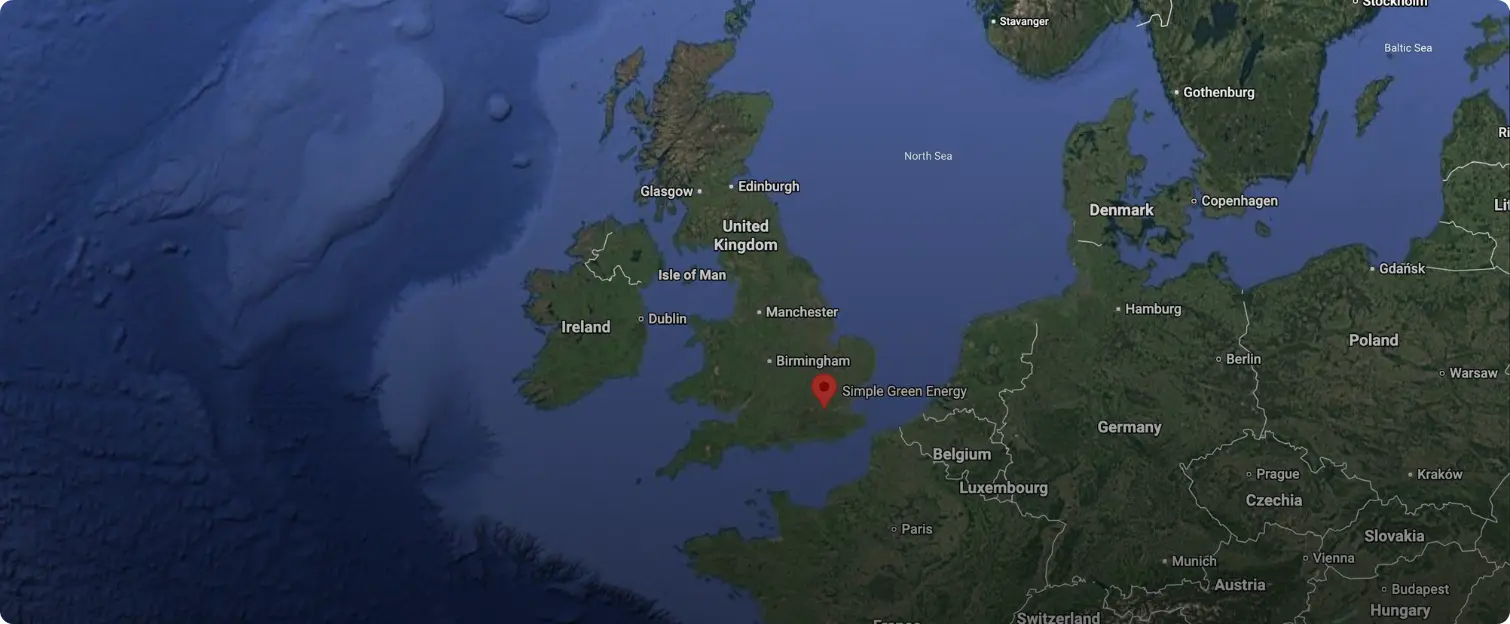
Simple Green Energy Ltd supports customers across Birmingham and the wider West Midlands with practical, survey-led energy advice.
For EV charger installation, Simple Green Energy Ltd can help with:
- home EV charger installation support
- Birmingham and West Midlands coverage
- charger advice based on your property and vehicle
- clear, itemised quotes
- grant eligibility checks where relevant
- safe and compliant installation
- DNO notification support
- solar PV and battery storage advice
- friendly aftercare after installation
The aim is not to sell the most expensive charger. It is to recommend a setup that fits your property, parking arrangement, electrical supply and charging habits.
How Much Does a Home EV Charger Cost in Birmingham? Final Cost Summary
The best way to understand how much does a home EV charger cost in Birmingham? is to match the quote to your property type. A driveway installation is usually simpler than a shared apartment car park, and a modern consumer unit is usually easier than an older electrical setup needing upgrades.
| Customer Type | Likely Installation Complexity | Cost Considerations | Best Next Step |
|---|---|---|---|
| Homeowner with driveway | Low to medium | Charger model, cable route, consumer unit condition, DNO notification | Request a standard home charger assessment |
| Terraced house owner | Medium to high | Off-street parking, cable route, front wall access, older electrics | Send photos of parking area and consumer unit |
| Flat owner | Medium to high | Leasehold permission, allocated bay, cable route, grant eligibility | Check freeholder/managing agent permission |
| Renter | Medium | Landlord consent, private parking, OZEV grant eligibility | Confirm landlord approval before booking |
| Landlord | Medium to high | Multiple tenants, parking allocation, grants, load management | Arrange a property or portfolio assessment |
| Customer with solar panels | Medium | Solar-compatible charger, export settings, daytime use, battery options | Ask for EV and solar integration advice |
| Customer needing consumer unit upgrade | High | Electrical remedial work, protection, testing, extra labour | Get an electrical assessment before installation |
A proper installation assessment is the safest way to avoid surprises and get the right charger for your home.
Frequently asked questions (FAQs)
Simple answers to common questions about home EV charger cost in Birmingham, 7kW chargers, grants, DNO notification, rented properties, flats and solar charging. Speak to Simple Green Energy.
Need an EV charger quote?
Speak with Simple Green Energy about home EV charger installation in Birmingham and the West Midlands, including charger choice, survey checks, grants, DNO notification, solar PV and battery storage.
Get EV charger adviceFinal CTA
Thinking about a home EV charger in Birmingham?
Simple Green Energy Ltd can help you choose the right charger, check your installation requirements and provide a clear, no-obligation quote for your property. We cover Birmingham and the wider West Midlands, including Solihull, Sutton Coldfield, West Bromwich, Walsall, Wolverhampton, Dudley, Halesowen and Coventry.
To get started, send us:
- a photo of your parking area
- a photo of your consumer unit
- the preferred charger location
- your EV model, if you already have one
- whether the property is owned, rented, leasehold or managed
You can also ask us about combining EV charging with solar PV and battery storage for a more joined-up home energy setup.