


Commercial Solar Grants and Funding for UK Businesses
Many UK businesses want to install solar panels, but the upfront investment can make the decision feel difficult. The good news is that businesses do not always need to fund the full project from cash reserves.
There are several ways to reduce, spread or recover the cost of commercial solar panels. These include local business grants, rural funding, public sector decarbonisation schemes, Smart Export Guarantee payments, tax allowances, asset finance and Power Purchase Agreements.
The important point is this: there is no single UK-wide grant that pays for every commercial solar installation.
Funding is usually local, sector-specific, time-limited or linked to how the project is financed. That means the best approach is not to search for “free solar panels for businesses”. It is to build a clear funding plan around your location, building type, electricity use and project timescale.
Get Your Solar Panel Quote
Start with your address so we can check the best solar options for your home.
Quick Answer: Are Solar Panels Worth It for Gurdwaras?
Yes, some UK businesses can access solar-related grants or funding support, but availability depends on location, sector, eligibility rules and whether the funding window is open.
The most realistic routes include:
- Local authority business grants
- Growth Hub and combined authority funding
- Rural business funding
- Public sector decarbonisation schemes
- Smart Export Guarantee export payments
- Capital allowances and tax relief
- Green asset finance
- Power Purchase Agreements
- Charity-building VAT relief in limited cases
Businesses should start by checking official grant search tools, local council funding pages, regional Growth Hubs and Ofgem’s business energy grant guidance. GOV.UK’s Find a Grant service lets organisations search government grants and check eligibility, while Ofgem provides a guide to business energy-efficiency grants and schemes.
Table of Contents
ToggleWhat Funding Routes Are Realistic for Commercial Solar?
A strong funding search starts with understanding which route actually fits your business.
| Funding Route | Best For | Key Point |
|---|---|---|
| Local business grants | SMEs, local employers, high-street businesses | Usually postcode-based and time-limited |
| Growth Hub support | SMEs seeking business efficiency upgrades | Availability depends on region |
| Rural funding | Farms, rural SMEs, community buildings | Often capital-focused with strict eligibility |
| Public sector schemes | Schools, councils, NHS, emergency services | Not usually for private companies |
| Smart Export Guarantee | Businesses exporting surplus solar electricity | Export payment, not an upfront grant |
| Capital allowances | Businesses buying the system outright | Accountant advice is essential |
| Asset finance | Businesses wanting ownership without full upfront spend | Repayments spread over time |
| PPA | Businesses wanting solar with no capital outlay | Third party owns the system |
| Charity VAT relief | Certain charitable buildings | Does not apply to ordinary commercial premises |
The right route depends on ownership, cash flow, tax position, site use and how quickly the business wants to install.
1. Local Business Grants
For most SMEs, local funding is the first place to check.
Many commercial solar grants are delivered through councils, combined authorities or business support programmes. These schemes often support projects that reduce energy use, lower emissions or improve business resilience.
The challenge is that local grants are not consistent across the UK. One council may offer match funding for solar panels, while another may only support audits, LED lighting or wider energy-efficiency work.
Typical local grant rules may include:
- The business must be located in a specific area.
- The applicant may need to be an SME.
- The project must not start before approval.
- The business may need to provide match funding.
- A quote, carbon-saving estimate or energy audit may be required.
- The project must be completed before a deadline.
The UK Shared Prosperity Fund has supported local business investment, including energy-efficient and low-carbon technologies, with further allocations for 2025–26 focused on local investment and business support.
For businesses, this means local authority and Growth Hub pages are worth checking before signing a solar contract.
2. Local Growth Fund and Regional Business Support
From 2026 onward, businesses should also watch for Local Growth Fund-backed regional programmes.
GOV.UK’s technical document for the Local Growth Fund in England describes three broad areas: infrastructure investment, business support and skills development. The business support theme is aimed at strengthening regional clusters and increasing innovation and investment.
This does not automatically mean every solar project will qualify. However, it does mean regional business support remains part of the funding landscape.
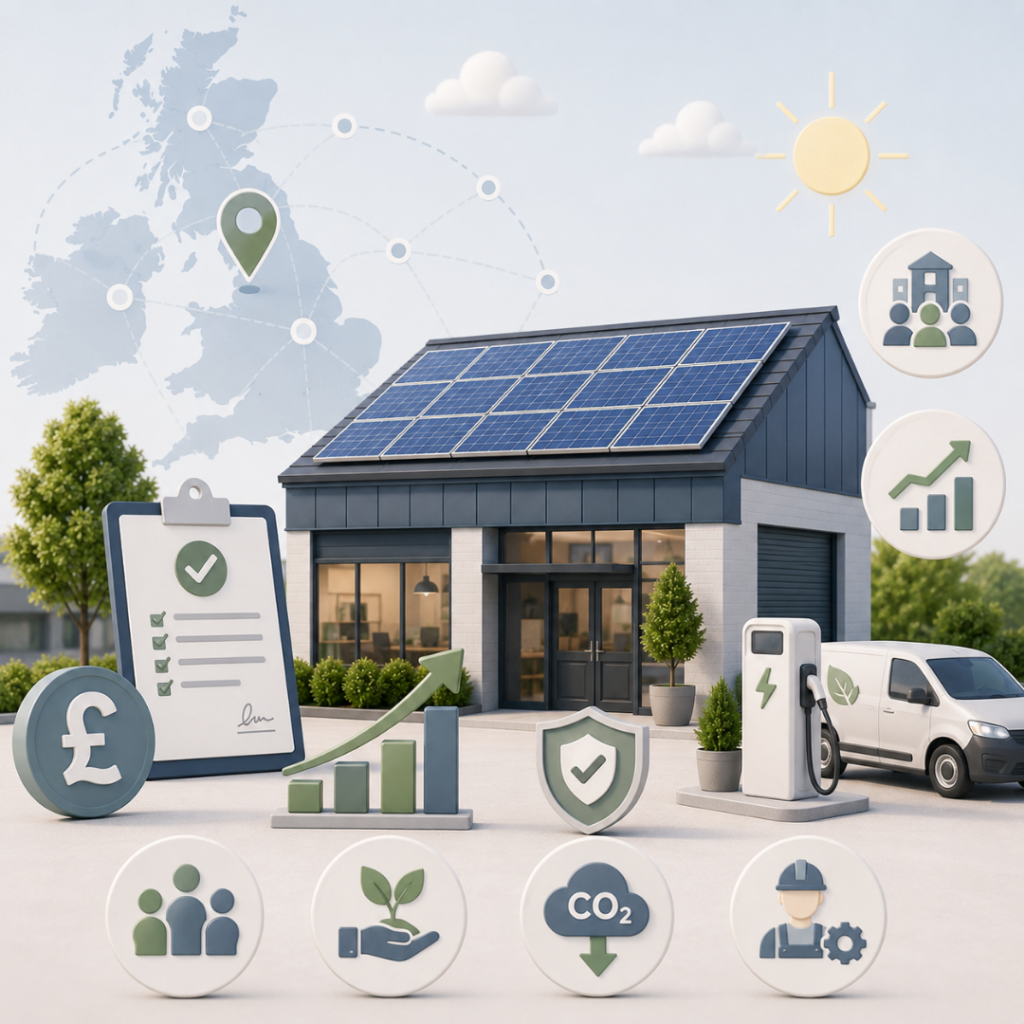
A solar project is more likely to be taken seriously if it is presented as part of a wider business improvement plan, such as:
- Reducing operating costs
- Supporting growth
- Improving resilience
- Cutting carbon emissions
- Preparing for EV charging
- Upgrading an inefficient site
- Supporting local jobs or services
Funding bodies usually want more than a panel quote. They want to understand the business case.
3. Rural and Agricultural Funding
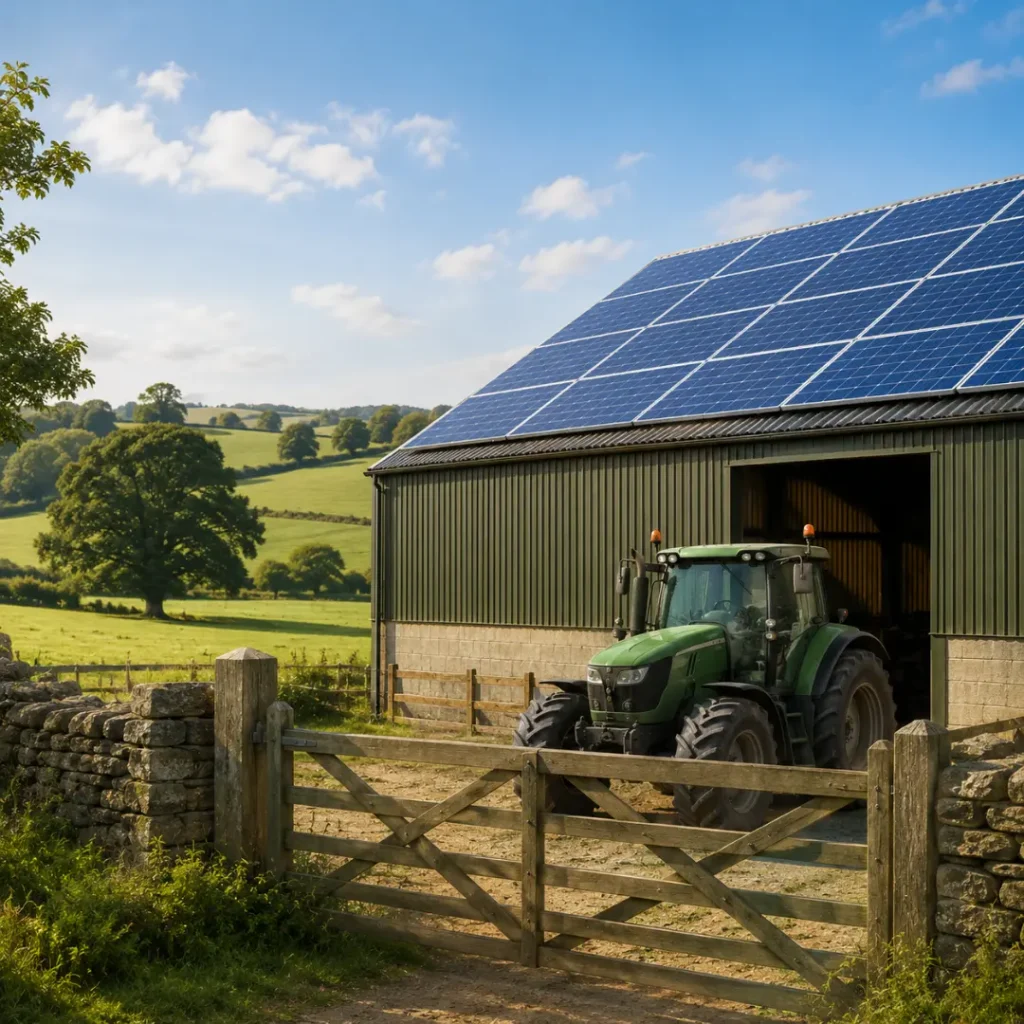
Rural businesses may have additional routes to explore. The Rural England Prosperity Fund supports capital projects for business or community purposes. GOV.UK states that grants must be spent on lasting assets such as buildings or equipment, and cannot be used for domestic property improvements or revenue costs.
This can be relevant for some farms, rural SMEs, rural tourism businesses and community assets, depending on the local programme.
A rural solar application is usually stronger when it explains how the project will:
- Reduce energy bills
- Improve productivity
- Support diversification
- Reduce carbon emissions
- Protect the business from energy price volatility
- Improve long-term site resilience
Farmers and rural business owners should check the local authority or rural funding delivery body before assuming eligibility.
4. Smart Export Guarantee
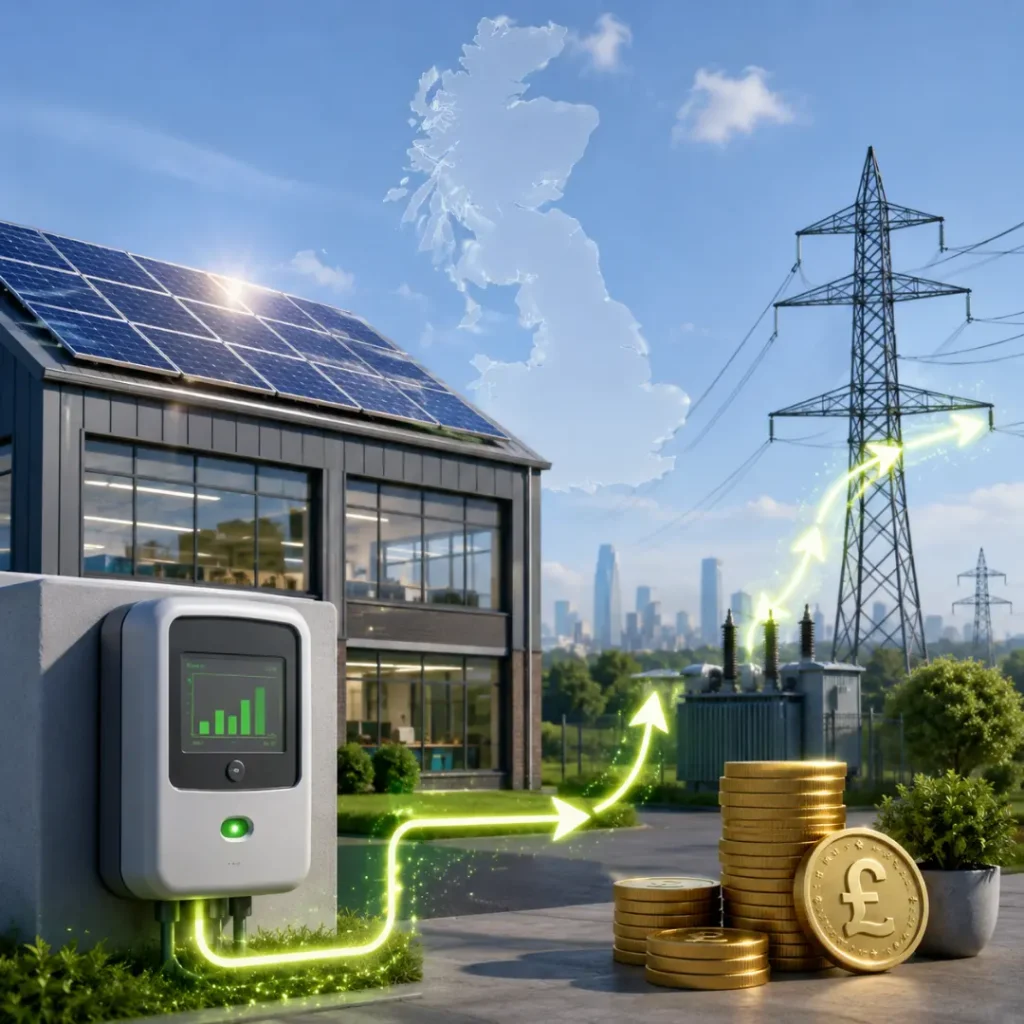
The Smart Export Guarantee, often called SEG, is not a grant. It is an export payment scheme.
It allows eligible small-scale low-carbon generators to receive payments from electricity suppliers for electricity exported back to the grid. Ofgem confirms that solar PV is an eligible technology and that installations can qualify up to 5MW, provided the relevant criteria are met.
For commercial solar, SEG can help improve the business case when the site exports unused electricity.
However, businesses should treat export income carefully. The main financial benefit of solar usually comes from using electricity on site, because that reduces electricity purchased from the grid. SEG is useful, but it should not be the only reason for installing solar.
Before relying on SEG income, check:
- Whether the system is eligible
- Whether the installation meets certification requirements
- Whether the business has a suitable export meter
- Which supplier offers the best tariff
- Whether export limits apply to the site
- How export income affects the payback model
A good installer should separate estimated bill savings from estimated export income so the numbers are clear.
5. Capital Allowances and Tax Relief
Businesses buying solar panels outright should speak to their accountant before making a final decision.
Solar panels can fall under capital allowances, but the rules are not as simple as “100% tax relief for every business”.
GOV.UK guidance states that companies cannot claim full expensing for special rate assets such as solar panels, although these may qualify for the 50% special rate allowance instead. HMRC’s capital allowances manual also states that expenditure on solar panels and the electrical system may be eligible for the 50% First-Year Allowance, Annual Investment Allowance or special rate writing-down allowances.
GOV.UK also lists solar panels in the special rate pool, where writing-down allowances can apply at 6%.

This is why tax advice matters. The installer can provide the project cost, but an accountant should confirm how the business can treat the investment.
Before approving the project, ask your accountant:
- Can the business claim Annual Investment Allowance?
- Does the project qualify for special rate treatment?
- Is any 50% first-year allowance available?
- How does the company structure affect the claim?
- How will finance or leasing change the tax position?
- What happens if the system is installed on leased premises?
This step can make a major difference to the real net cost of the project.
6. Power Purchase Agreements
A Power Purchase Agreement, or PPA, is often suitable for businesses that want solar panels but do not want to pay the full upfront cost.
Under a typical PPA, a third party funds, owns and maintains the solar system. The business then buys the electricity generated by the panels at an agreed rate.
This can be attractive because it may offer:
- No upfront capital cost
- Lower electricity rate than grid supply
- Maintenance included
- Long-term price visibility
- A route to sustainability improvements without ownership

However, a PPA is a long-term commercial contract. It should be reviewed carefully.
Key questions include:
- Who owns the system?
- How long is the agreement?
- What price will the business pay per kWh?
- Is the price linked to inflation?
- Who maintains the system?
- What happens if the business moves premises?
- Can the agreement transfer to a buyer or tenant?
- Is there a buyout option?
A PPA can work well, but it is not the same as owning the solar system. Ownership usually gives stronger long-term returns, while a PPA can help preserve cash.
7. Asset Finance and Green Business Loans
Asset finance is another option for businesses that want ownership but prefer not to use cash reserves.
Instead of paying the full cost upfront, the business spreads payments over an agreed term. This can help match repayments against energy savings.
Funding options may include:
- Hire purchase
- Lease finance
- Green business loans
- Equipment finance
- Bank lending
- Supplier-backed finance

The advantage is that the business can still move toward ownership while protecting cash flow. The drawback is that finance costs must be included in the savings model.
Before choosing finance, compare:
- Monthly repayment
- Expected monthly bill saving
- Interest rate
- Total repayable amount
- Ownership position
- Early repayment terms
- Tax treatment
- Maintenance responsibilities
A finance option should be judged on net business benefit, not just whether the monthly payment looks affordable.
8. Public Sector Decarbonisation Funding
Public sector organisations have different funding routes from private businesses.
The Public Sector Decarbonisation Scheme, delivered through Salix, provides grant funding for eligible public sector projects that meet scheme criteria.
This may be relevant for:
- Schools
- Colleges
- Universities
- NHS sites
- Councils
- Emergency services
- Public leisure buildings
- Some publicly owned community assets
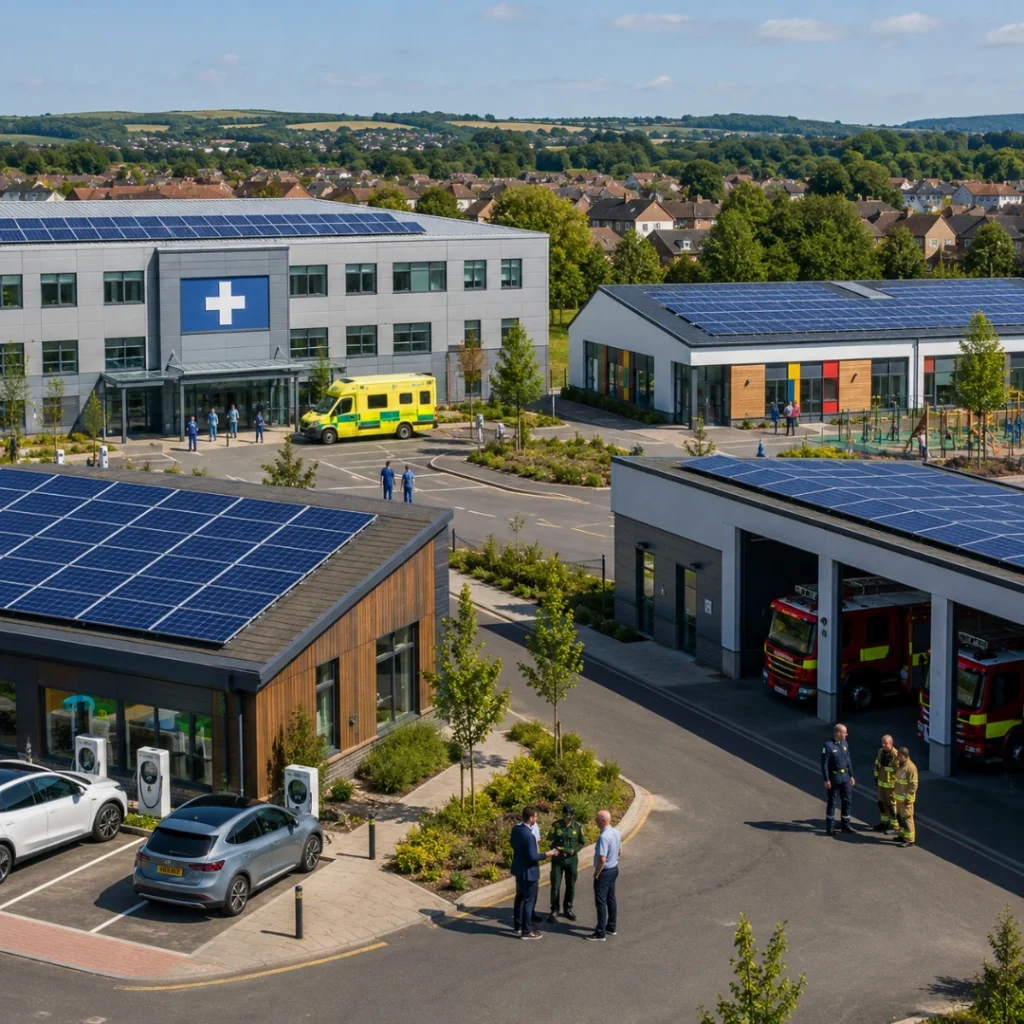
Public sector solar is often assessed as part of a wider decarbonisation plan rather than as a standalone panel installation.
Organisations may need:
- Estate owner approval
- A heat decarbonisation plan
- Project governance
- Procurement compliance
- Carbon reduction calculations
- Delivery deadlines
- Evidence of existing energy use
Private SMEs should not rely on public sector schemes, but public bodies should review them early in the planning process.
9. VAT Relief for Charitable Buildings
VAT relief is often misunderstood.
HMRC guidance says a zero rate applies to the installation of certain specified energy-saving materials from 1 May 2023 to 31 March 2027, with the rate due to return to 5% from 1 April 2027. The guidance includes residential accommodation and charitable buildings in specific circumstances.
This does not mean ordinary commercial premises automatically receive 0% VAT on solar installations.
VAT treatment may be relevant for:
- Certain charitable buildings
- Places of worship
- Community buildings
- Residential accommodation
- Mixed-use buildings
Before relying on VAT relief, the organisation should ask for written confirmation and check the position with an accountant or tax adviser.
How to Prepare Before Applying for Solar Funding
Grant windows can close quickly. The businesses that move fastest are usually the ones with documents ready.
Before applying, prepare:
- 12 months of electricity bills
- Half-hourly data, if available
- Current electricity tariff
- Site address
- MPAN details
- Roof photos or drawings
- Evidence of business status
- Landlord permission, if leased
- Latest accounts, if required
- A solar quote
- Estimated carbon savings
- Estimated bill savings
- Project timeline
- Planning or grid notes, where relevant
Do not start installation before checking the funding rules. Many grant schemes will reject costs that were committed before approval.
Common Mistakes Businesses Should Avoid
The biggest mistake is assuming a national solar grant exists for every business. It does not.
Other common mistakes include:
- Starting work before grant approval
- Applying without a proper quote
- Missing the funding deadline
- Ignoring landlord consent
- Forgetting grid connection checks
- Assuming export income is guaranteed
- Treating SEG as an upfront grant
- Assuming VAT relief applies automatically
- Claiming tax relief without accountant advice
- Applying for public sector funding as a private business
- Choosing finance without comparing total repayable cost
Funding can help, but only when the project is structured correctly.
Which Solar Funding Option Is Best?
There is no single best option for every business.
A cash-rich business that owns its building may prefer outright purchase because it keeps full ownership and long-term savings.
A growing SME may prefer asset finance to protect cash flow.
A business with no capital budget may consider a PPA.
A rural business may look for local or rural grant support.
A school or council site may need a public sector decarbonisation route.
A charity or place of worship may need to review VAT treatment and community funding.
The best solar funding route is the one that fits the organisation’s cash position, ownership structure, site plans and long-term energy goals.
Final Thoughts
Commercial solar funding in the UK is available, but it is rarely simple.
Businesses should avoid waiting for a perfect national grant and instead build a practical funding plan. That plan should include local grant checks, tax advice, export tariff review, finance comparison and a clear solar proposal based on real electricity usage.
The most successful projects are usually the ones that are quote-ready before funding opens.
That means having the bills, roof information, carbon-saving estimate and business case prepared in advance.
Get Help Finding Commercial Solar Funding
Simple Green Energy can help UK businesses review the most suitable route for commercial solar, including:
- Local grant checks
- Solar funding options
- SEG export income
- Asset finance
- PPA suitability
- Tax and VAT questions to ask your accountant
- Commercial solar quotes
- Carbon and bill-saving estimates
- Documents needed for funding applications
Send us a recent electricity bill and we can help you understand which commercial solar funding route may work for your business.
Frequently asked questions (FAQs)
Simple answers to common questions about commercial solar grants and funding options in the UK, including local grants, SME support, Power Purchase Agreements and where businesses should check first. Speak to Simple Green Energy.
Need help finding solar funding?
Speak with Simple Green Energy about commercial solar grants, funding options, local schemes, system sizing, electricity bill reviews and installation planning for your business.
Get solar funding adviceSources Checked
- GOV.UK Find a Grant
- Ofgem business energy-efficiency grants guide
- Ofgem Smart Export Guarantee guidance
- UK Shared Prosperity Fund 2025–26 technical note
- Rural England Prosperity Fund guidance
- GOV.UK capital allowances guidance
- VAT Notice 708/6
- Salix Public Sector Decarbonisation Scheme
- Planning Portal non-domestic solar guidance
Funding rules, grant windows and eligibility criteria can change quickly. Always check the official scheme page before committing to installation work or signing a contract.