
Solar Panels Only vs Solar Panels with Battery Storage: Which Is Better for UK Homes?
Solar panels generate electricity from daylight, reducing the power you buy from the grid. Adding battery storage lets you keep surplus solar electricity for later, usually during the evening or early morning.
The better option depends on when you use electricity, your budget, export tariff and plans for an electric vehicle or heat pump. Solar panels only usually offer the simplest, lowest-cost route to smaller bills. Solar panels with battery storage can provide greater energy independence, but the extra cost does not automatically create a faster payback.
This guide compares both options, explains current UK costs and shows what to check before accepting a quotation.
Get Your Solar Panel Quote
Start with your address so we can check the best solar options for your home.
Quick answer
Choose solar panels only when your priority is lower upfront cost, you use plenty of electricity during daylight hours, or you can schedule appliances and EV charging for sunny periods.
Choose solar panels with battery storage when most of your electricity use happens after sunset, you want to reduce peak-rate imports, or you plan to use a smart time-of-use tariff.
A battery improves flexibility, not solar generation. It stores electricity that might otherwise be exported, but it adds cost, incurs conversion losses and normally needs replacing before the panels. Base the decision on real consumption data, expected generation, import and export rates, and battery lifespan.
Table of Contents
Toggle| Factor | Solar Panels Only | Solar Panels with Battery Storage |
|---|---|---|
| Upfront cost | Lower | Higher |
| Evening solar use | Not available directly | Stored solar can be used later |
| Grid dependence | Reduced mainly in daylight | Reduced across more of the day |
| Export income | Usually higher | Usually lower unless the battery is full |
| Complexity | Simpler | More equipment and settings |
| Best for | Budget-led and daytime users | Evening users and smart-tariff homes |
Solar panels only
Overview and best use
A solar-only system includes solar panels, an inverter and monitoring equipment. Solar electricity powers the home first; unused generation is exported.
Eligible generators in England, Scotland and Wales can receive payments through the Smart Export Guarantee. However, energy suppliers set their own export rates, contract terms and eligibility conditions.
Solar only often suits homeowners who want a lower initial investment, work from home, run appliances during the day or can schedule washing, water heating and EV charging around solar generation.
Advantages
The system is comparatively simple, with fewer components to buy, configure and eventually replace.
Energy Saving Trust currently estimates that a typical domestic solar system is around 4.5kWp and costs approximately £7,600. Roof access, scaffolding, equipment selection, shading and system design can all affect the final price.
Solar panels should generally last 25 years or more, although the inverter may need replacing sooner.
Things to consider
Electricity generated when nobody is using it is exported. This electricity is not wasted because it may earn an export payment, but buying electricity later frequently costs more per unit than exporting it earns.
Timers, smart plugs, solar-compatible EV chargers and hot-water diverters can improve solar self-consumption without installing a battery.
Example UK use case
Consider a couple who work from home and have an EV parked on the drive during daylight hours. They may be able to use a high proportion of their solar generation directly.
In this situation, installing the largest sensible panel array may provide better long-term value than diverting part of the budget to battery storage.
Expert recommendation
Prioritise roof utilisation and good system design. Solar panels create the energy; a battery only moves that energy from one time of day to another.
Solar panels with battery storage
Overview and best use
A solar-plus-battery system stores surplus generation and releases it when the home needs electricity. Many modern batteries can also charge from the grid during cheaper tariff periods.
Battery storage is most attractive for households that are empty during the day, use more electricity in the evening, have an EV or heat pump, or want to reduce their reliance on peak-rate grid electricity.
Advantages
A battery can increase solar self-consumption, reduce peak-rate imports and support smart time-of-use tariff strategies. Energy Saving Trust notes that batteries can store daytime solar electricity, avoid expensive tariff periods and, with certain tariffs, potentially export electricity at more valuable times.
Some battery systems can power selected circuits during an electricity cut. However, backup power must be included in the system design; it should never be assumed to come as standard.
Installing solar panels and storage together may also reduce duplicated labour, electrical and commissioning costs.
Things to consider
Compare usable battery capacity rather than headline capacity. You should also check:
- Continuous power output
- Round-trip efficiency
- Product and installation warranties
- Cycle or energy-throughput limits
- Operating temperature requirements
- Expansion options
- Grid-charging capability
- Backup power functionality
Energy Saving Trust gives a typical battery lifespan of approximately 10 to 12 years and warns that storing and releasing electricity loses some energy.
An oversized battery may spend much of the year partly empty or underused.
Example UK use case
A family leaves home at 8am and returns after 5pm. Their solar panels generate most strongly while the property is quiet.
A correctly sized battery can capture part of that surplus and use it for cooking, lighting, entertainment and appliances later in the day.
Expert recommendation
Size storage from electricity consumption and solar-generation data, not bedroom count or a salesperson’s standard package.
How to compare both options
Directly used solar normally creates the greatest saving because it replaces imported electricity.
Exported solar earns the applicable export rate. Stored solar replaces electricity that would otherwise be imported later, but the calculation must allow for battery losses, degradation and capital cost.
Compare quotations using the same panel quantity, generation estimate, tariff assumptions and household consumption profile. Otherwise, one option can appear better simply because the salesperson has used more favourable assumptions.
Check:
- Expected annual solar generation
- Roof orientation and shading losses
- Estimated self-consumption with and without storage
- Usable battery capacity and power output
- Import and export tariff assumptions
- Warranty and retained-capacity guarantees
- Backup power capability
- Compatibility with a future EV or heat pump
- Total purchase and finance costs
- Potential inverter and battery replacement costs
Which option is best for your household?
| Household or priority | Usually better option | Reason |
|---|---|---|
| Lowest upfront cost | Solar only | Lower capital expenditure |
| Home occupied during the day | Solar only | More electricity can be used directly |
| Empty home on weekdays | Solar plus battery | Daytime surplus can be shifted to evenings |
| EV charged mainly in daylight | Solar only or smaller battery | The vehicle can absorb solar generation |
| EV charged overnight | Solar plus battery and smart tariff | Greater tariff flexibility |
| Heat-pump household | Solar plus battery | Higher electrical demand creates more opportunities to use stored power |
| Attractive export tariff | Solar only may compete well | Exported electricity has greater value |
| Power-cut backup | Battery with dedicated backup design | Standard systems may shut down during an outage |
Costs, savings and payback
Energy Saving Trust’s July 2026 guidance estimates a typical 4.5kWp domestic solar system at around £7,600. Its battery guidance gives an indicative cost of approximately £4,600 for a 5kWh battery, with battery-storage systems ranging from roughly £1,500 to £10,000.
A typical combined solar and 5kWh battery system might therefore cost around £12,200 before property-specific adjustments. A joint installation may reduce duplicated labour and integration costs.
Current Energy Saving Trust examples indicate solar payback periods of approximately nine to twelve years across selected UK locations. These examples include export payments and vary according to location and household occupancy.
Battery payback is less predictable. It depends heavily on:
- Import and export electricity rates
- Time-of-use tariff availability
- How frequently the battery completes useful cycles
- Battery losses and degradation
- Whether the battery needs replacing before the investment is recovered
For an accurate quotation, the installer should survey your roof and electrical system, assess shading, review at least 12 months of electricity use and model more than one tariff scenario.
Be cautious where forecasts assume energy prices will rise indefinitely, ignore battery degradation or use an unrealistically high percentage of stored electricity.
Eligible residential solar panels and electrical storage batteries currently qualify for temporary zero-rate VAT until 31 March 2027.
How to choose the right system
- Review your electricity data. Use annual consumption and, where available, half-hourly smart-meter data.
- Assess your roof. Check orientation, shading, roof condition, pitch and usable area.
- Model the largest sensible solar array. The panels are the part of the system that generates energy.
- Calculate solar-only savings first. Establish expected generation, direct use, exports and payback before adding storage.
- Add a correctly sized battery scenario. Compare its additional cost with its additional annual saving.
- Test different tariffs. Import and export rates can materially change the result.
- Review all warranties separately. Check the solar panel, inverter, battery and workmanship warranties.
- Include future plans. Tell the designer about a possible EV, heat pump, extension or increased home working.
- Obtain at least three itemised quotations. Require every provider to explain the assumptions behind their savings forecast.
Why the installer matters
Installation quality affects electrical safety, solar generation, battery performance, warranty validity and system lifespan.
Poor string design, avoidable shading, unsuitable battery placement, limited monitoring or incorrect settings can undermine otherwise good equipment.
Energy Saving Trust recommends obtaining quotations from MCS-certified installers. MCS standards cover the design and installation of solar PV and battery-storage systems, while certification can also be important when applying for certain export tariffs.
Ask for:
- An itemised proposal
- A system performance estimate
- Product datasheets
- Warranty terms
- Electrical diagrams
- Monitoring information
- Handover documents
- Export-registration guidance
- A written explanation of backup functionality
A trustworthy installer should explain both why battery storage may help and why it may not.
Book a free home survey: Simple Green Energy can compare solar-only and solar-plus-battery options using realistic assumptions for your property.
Recommended visual evidence
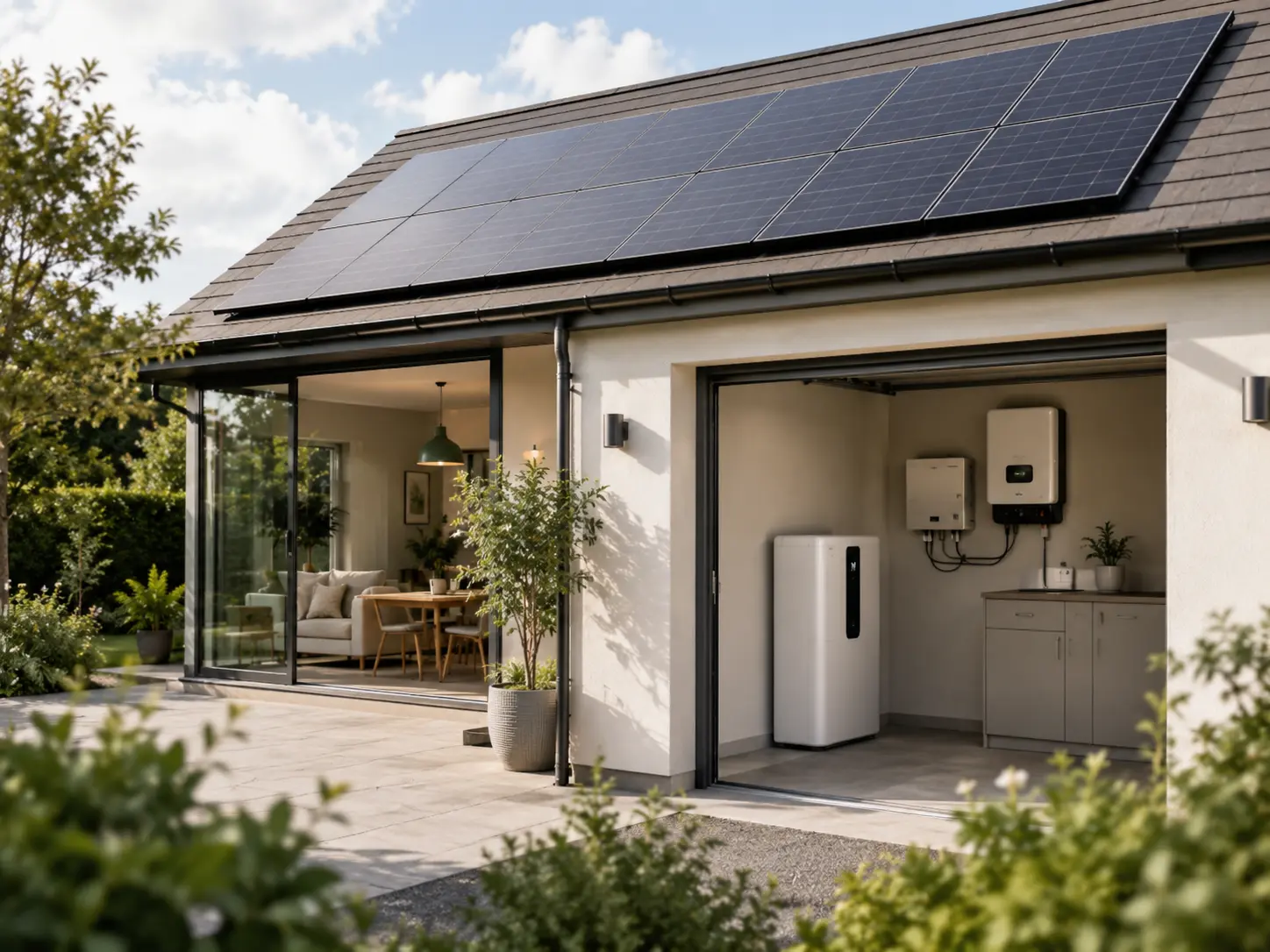
Add a labelled photograph of a completed solar-only installation beside the first option and a solar-plus-battery installation beside the second.
After the comparison section, include a simple 24-hour graphic showing midday solar generation, household demand and evening battery discharge.
Near the cost guide, use an anonymised case study showing the system size, annual generation, self-consumption and tariff assumptions. Installation photographs, monitoring screenshots and engineer commentary will build more trust than generic stock imagery.
Frequently asked questions (FAQs)
Clear answers about choosing solar with or without a battery, storage payback, winter charging, backup power, retrofitting and battery sizing. Speak to Simple Green Energy .
Unsure whether to add a solar battery?
Speak with Simple Green Energy about evening electricity use, tariff options, battery capacity, backup requirements and whether storage is likely to improve your system’s overall value.
Compare solar and battery optionsConclusion:
Solar panels only generally provide the lower-cost, simpler route to clean electricity and suit households able to use power during the day.
Solar panels with battery storage provide more control and can work particularly well for evening users, EV owners, heat-pump households and smart-tariff customers.
Neither option is automatically better. Prioritise a productive solar array, size storage conservatively and judge the battery by its additional lifetime value—not only by the headline reduction in grid imports.