
High-Efficiency vs Standard Solar Panels for Small Roofs: Which Is Best?
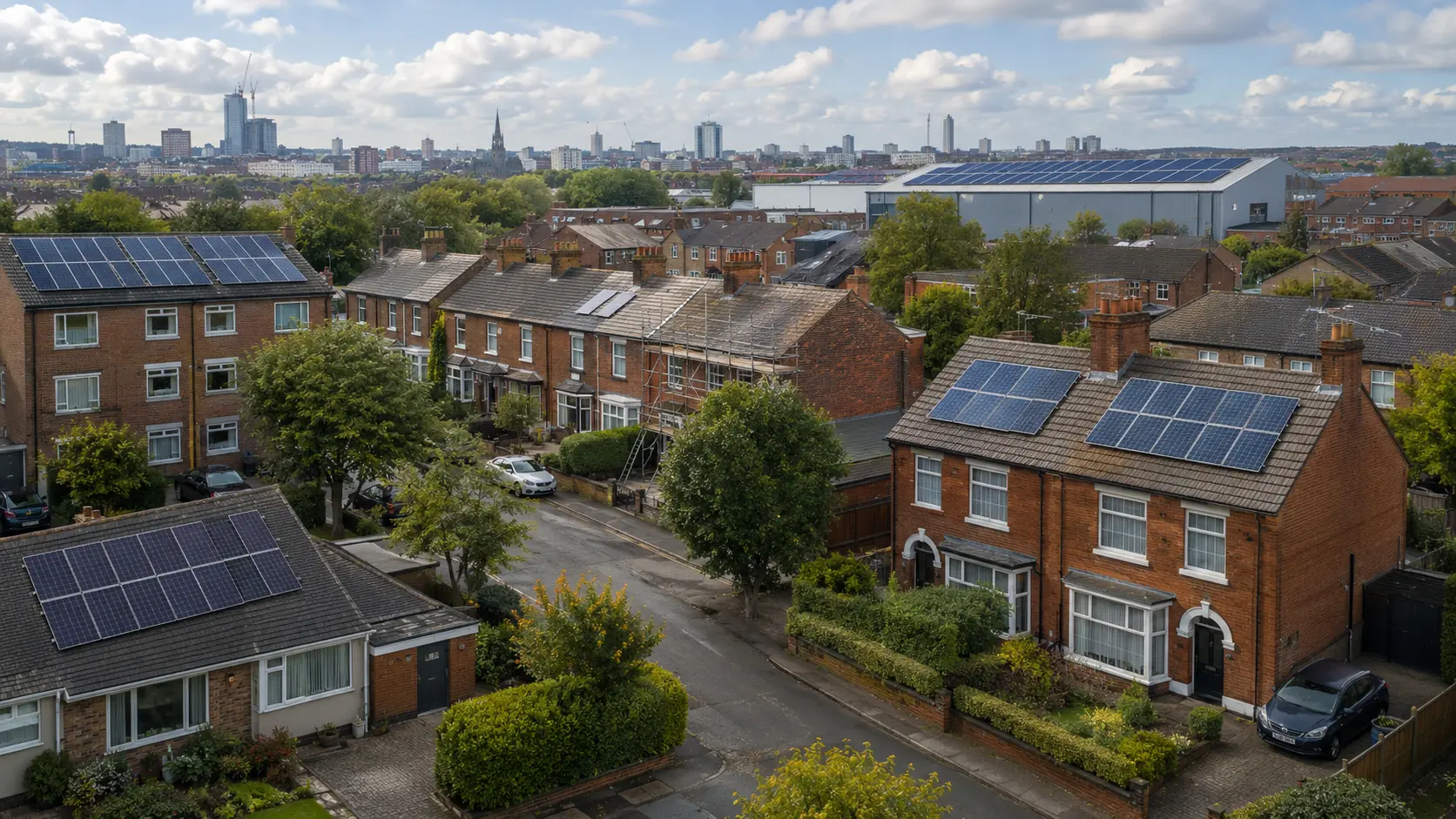
If your UK home has a small, awkward or partly obstructed roof, choosing solar panels is not simply a question of buying the highest-wattage model. The important measure is how much usable power the installer can fit into the available, unshaded area.
High-efficiency panels convert more sunlight into electricity per square metre, so they can produce a larger system from the same roof. Standard panels usually cost less and may deliver better value where there is enough room to meet your target system size. Current residential products illustrate the gap: mainstream modules commonly sit around 22% efficiency, while premium domestic panels can exceed 24%.
Get a free roof assessment: Simple Green Energy can model your usable roof area, shading and projected annual generation before recommending a panel.
Get Your Solar Panel Quote
Start with your address so we can check the best solar options for your home.
Quick answer
For a genuinely small roof, high-efficiency solar panels are usually the better choice when they allow you to install meaningfully more kilowatts peak (kWp) within the same usable area.
However, premium is not automatically better. Compare complete system output, projected annual generation, warranty and installed cost—not the panel-efficiency percentage in isolation.
Standard panels can offer better value if the roof already fits enough capacity. Premium panels make most sense where chimneys, dormers, skylights, fire-safety clearances or shading restrict the number of modules. Layout and forecast matter more than headline wattage.
Table of Contents
ToggleQuick comparison
| Factor | High-efficiency panels | Standard panels |
|---|---|---|
| Typical efficiency position | Premium models, often above 23% | Mainstream models, commonly around 21–22.5% |
| Main advantage | More power from limited roof area | Lower equipment cost and strong value |
| Best for | Small, obstructed or high-demand roofs | Roofs with enough usable space |
| Main drawback | Higher price may not repay itself | Lower maximum system size on a tight roof |
| Buying priority | Watts per square metre and long-term yield | Installed cost per projected annual kWh |
What does solar-panel efficiency mean?
Panel efficiency is the share of incoming solar energy converted into electricity under standard test conditions. It determines power density, so similarly sized panels can have different wattages.
A physically larger 550W commercial panel is not necessarily better for a small roof than a compact 470W residential panel. Compare dimensions and watts per square metre.
REC, for example, lists a 470W residential module at 22.6% efficiency and 226W/m², while high-end AIKO residential products are advertised above 24% efficiency.
As an illustration, eight equal-sized 430W panels create a 3.44kWp array. Eight 470W panels create 3.76kWp—about 9% more rated capacity without adding another panel.
Annual generation also depends on location, orientation, pitch, shading and system design. Energy Saving Trust advises that installers assess shading across different times and seasons rather than relying on a simple roof-direction assumption.
High-efficiency solar panels
Overview and best use
High-efficiency panels use technologies such as n-type TOPCon, heterojunction or back-contact cells to increase output per square metre.
They suit terraced homes, interrupted roofs and households planning an electric vehicle or heat pump.
Key features and advantages
- Higher watts per square metre
- Potentially larger total array from the same roof
- Often paired with strong product and performance warranties
Things to consider
The extra efficiency must create useful output. Paying more is poor value if module dimensions or layout mean both proposals create the same system size.
Check product, performance and workmanship cover separately. A long performance warranty does not necessarily include installation labour or the cost of accessing the roof.
Example UK use case
A terraced home fits six modules around a dormer. Moving from 430W to 480W raises the array from 2.58kWp to 2.88kWp—useful when a seventh panel will not fit.
Expert recommendation
Choose high-efficiency panels when the quote shows a material increase in projected annual kWh, not merely a more impressive datasheet.
Standard solar panels
Overview and best use
“Standard” does not mean outdated or low quality. Many mainstream n-type panels now reach roughly 22% efficiency. One Jinko residential datasheet, for example, covers 430–455W modules with efficiencies from 21.52% to 22.77%.
They suit roofs that already accommodate the desired array and buyers prioritising budget and payback.
Key features and advantages
- Competitive installed cost
- Strong output where roof space is not the limiting factor
- Better potential return if premium efficiency adds little generation
Things to consider
A cheaper panel can be a false economy if it forces a much smaller system.
Check degradation, temperature coefficient, manufacturer support and replacement availability. The cheapest module is not necessarily the lowest-cost option over the system’s working life.
Example UK use case
A semi-detached home fits ten standard panels and meets its 4–4.5kWp target. If premium panels do not improve usable generation enough, the lower-cost proposal may win.
Expert recommendation
Choose a reputable standard panel when roof space is sufficient and the installer can demonstrate similar annual generation at a lower total cost.
How to choose the right panels for a small roof
- Measure usable area. Exclude skylights, chimneys, vents, shaded zones and necessary clearances.
- Compare layouts. Ask for panel dimensions, panel quantity, array capacity in kWp and a roof plan.
- Compare annual generation. Projected kWh is more useful than kWp alone because it accounts for the conditions affecting your property.
- Check shading. Optimisers or microinverters can reduce some losses but cannot rescue a poor layout. Energy Saving Trust notes that some systems can minimise shading impacts with optimisers.
- Review warranties. Separate panel, performance, inverter and installer-workmanship cover.
- Match demand. EV and heat-pump users may value extra capacity; low-use homes may not.
- Calculate whole-system value. Compare installed cost per projected annual kWh and test the assumptions used in each forecast.
Families and EV owners may benefit from premium efficiency when they can use the extra output.
Landlords may prefer a well-priced standard system that reduces running costs without overcapitalising. Space-limited businesses with steady daytime electricity demand often benefit from maximum power density.
UK solar-panel cost guide
A typical home solar installation currently costs around £7,600 according to Energy Saving Trust, while a June 2026 UK market guide places many three-bedroom installations around £6,500–£9,000.
Costs vary with system size, scaffolding, roof complexity, inverter selection and electrical work.
| Cost item | Practical budgeting guidance |
|---|---|
| Typical home solar system | Around £7,600 as a broad UK benchmark |
| Common 2026 three-bedroom range | Approximately £6,500–£9,000 installed |
| High-efficiency upgrade | Request an itemised uplift; there is no universal premium |
| Roof or electrical remedial work | Property-specific and survey-dependent |
| Accurate quotation | Requires a roof, shading and electrical assessment |
Solar panels installed on eligible homes in Great Britain currently qualify for 0% VAT.
Exported electricity may earn Smart Export Guarantee payments, but suppliers set their own rates and contract terms.
Will high-efficiency panels save more money?
They usually generate more electricity from the same area, but value depends on the price premium and how much of the extra electricity you use or export.
Ask the installer to model both options. Compare the additional installed cost with the additional projected annual and lifetime generation.
What is the payback period?
Payback depends on system cost, generation, self-consumption, electricity prices, export tariff and finance.
A household that uses more solar electricity while it is being generated may achieve a different return from one that exports most of its production. Prefer a survey-based forecast to a generic national promise.
Do solar panels work in winter?
Yes. Solar PV uses daylight, not heat, but shorter days mean lower winter output.
Judge the system on projected annual generation rather than expecting equal monthly production. A larger proportion of annual electricity will normally be generated during spring and summer.
What about shading and maintenance?
High efficiency does not make shade harmless. Chimneys, trees and neighbouring buildings can materially affect output, so shading should be modelled throughout the year.
Panels are generally low maintenance, but owners should monitor generation, control nearby vegetation and follow manufacturer guidance.
Can a battery be added later?
Often yes, but compatibility depends on the inverter, electrical installation and product ecosystem.
Discuss future batteries, EV charging or heat pumps before choosing equipment. Installing a suitable hybrid inverter initially may simplify a later battery installation, although it will not always be the most economical option.
Why the installer matters more than a small efficiency difference
Installation quality affects roof integrity, electrical safety, cable routing, performance, monitoring, warranties and reliability.
Building regulations normally apply, including checking whether the roof can carry the system. Most domestic installations in England are permitted development, but limits and special-property rules apply.
Use an MCS-certified installer, obtain at least three quotes and insist on transparent generation assumptions. MCS describes itself as the UK quality mark for small-scale renewables and advises consumers to seek multiple quotations.
A professional proposal should clearly show:
- Panel make, model and dimensions
- Roof layout and usable area
- Shading assumptions
- Array size in kWp
- Projected annual generation in kWh
- Inverter and monitoring equipment
- Product and workmanship warranties
- Scaffolding and electrical work
- Total installed price
- Estimated savings and export assumptions
Book a free home survey: Simple Green Energy can compare standard and high-efficiency layouts using the same roof and consumption information, allowing you to see whether the premium produces worthwhile additional generation.
Panel wattage rarely determines the final installation price by itself. Scaffolding, roof access, mounting design, inverter choice, electrical upgrades and labour can outweigh the price difference between modules.
Energy Saving Trust currently gives approximately £7,600 as the average installed cost of a typical 4.5kWp domestic solar system. Actual prices depend on the roof, equipment, installation complexity and any associated building work.
Professional installation of qualifying energy-saving materials in residential accommodation is currently zero-rated for VAT until 31 March 2027. From April 2027, the rate is scheduled to revert to 5% unless the rules are changed.
Surplus electricity can earn payments through the Smart Export Guarantee. Electricity suppliers set their own rates, eligibility conditions and contract terms. Some of the highest-paying tariffs require customers to use a particular import tariff, installer, battery or related service, so the headline export rate should not be considered in isolation.
Payback should be calculated using:
- A property-specific generation forecast.
- The proportion of solar electricity used at home.
- Grid electricity costs avoided.
- Export tariff payments.
- Maintenance and potential inverter replacement.
- Battery costs, where applicable.
- Interest and total repayable cost if finance is used.
A 4.5kWp system will not necessarily deliver better financial returns than a 4.3kWp system if the additional capacity is shaded, poorly oriented or significantly more expensive.
Winter output, batteries and maintenance
Both panel sizes work during winter and on cloudy days. Output falls because winter has fewer daylight hours, lower sun angles and lower solar irradiation. Panel technology, shading, orientation and total array capacity matter more than choosing 430W or 500W in isolation. Energy Saving Trust confirms that solar panels continue generating on cloudy days.
Solar panels contain no moving parts and are effectively silent. Routine maintenance normally involves monitoring generation, checking for faults and arranging inspection or cleaning if dirt, debris, nesting birds or nearby vegetation affect performance.
A battery can often be added later, provided the inverter, electrical design and available space support the proposed system. Planning cable routes and the inverter strategy during the original installation can make a later battery upgrade easier.
How to choose the right solar panel size
- Obtain a measured roof survey and detailed panel layout.
- Compare at least two viable designs, including total kWp.
- Request annual generation and financial forecasts for each design.
- Check shading at different times of day and year.
- Match the inverter’s input limits and output rating to the array.
- Review product, performance and workmanship warranties.
- Compare finance using the total amount repayable.
- Confirm MCS certification, grid requirements and export metering.
- Choose lifetime value rather than the largest wattage label.
Aggregate inverter capacity up to 3.68kW per phase will generally use the G98 connection route. Larger inverter capacities generally require the G99 process and prior Distribution Network Operator involvement. This threshold concerns inverter or export capacity, not simply the combined wattage of the panels.
Why the installer matters
Even high-quality panels can underperform when the survey, string design, mounting, weatherproofing or commissioning is poor.
A competent installer should:
- Inspect the condition and suitability of the roof.
- Confirm structural and mounting requirements.
- Model shading and expected generation.
- Select electrically compatible panels and inverters.
- Complete appropriate electrical protection.
- Manage Distribution Network Operator paperwork.
- Provide realistic performance estimates.
- Explain warranties, monitoring and aftercare.
MCS publishes the UK installation standard for solar PV and provides a directory for finding certified installers. MCS certification or equivalent evidence is also normally required when applying for a Smart Export Guarantee tariff.
Frequently asked questions (FAQs)
Clear answers about solar-panel efficiency, wattage, panel size, small roofs, shading, east-west layouts and choosing the right system capacity. Speak to Simple Green Energy .
Considering high-efficiency panels?
Speak with Simple Green Energy about roof dimensions, panel efficiency, power density, shading, system capacity and whether a premium high-efficiency module offers worthwhile value.
Compare my panel optionsConclusion:
High-efficiency panels are usually the strongest option when roof area—not budget—is the main constraint. Standard panels are often better value when the roof already accommodates the required system.
Do not choose by efficiency or wattage alone. Choose the design balancing annual generation, installed cost, warranties and future electricity use.
Simple Green Energy can compare both layouts and provide a survey-based quotation without relying on generic savings claims.