LONGi vs AIKO Solar Panels UK 2026: Which Is Best?
LONGi and AIKO both offer exceptionally efficient back-contact solar panels for UK homes. The useful question is therefore not “Which manufacturer is best?” but “Which exact panel creates the best system on this roof?”
AIKO’s NEOSTAR 3P54 reaches 500W and 25% efficiency. LONGi’s comparable Hi-MO X10 LR7-54HVH reaches 500W and 24.5%. That difference is small, but AIKO’s shorter module may enable a better layout where space is restricted. LONGi remains compelling because of its high output, established distribution and built-in shading technology.
This guide compares efficiency, warranties, shading, appearance, UK costs and suitability for homeowners, landlords, renovators and EV owners.
Get Your Solar Panel Quote
Start with your address so we can check the best solar options for your home.
Quick Answer
AIKO is usually better when usable roof area is the main limitation. LONGi is often the better all-round choice when it provides the required system size at a lower installed price.
The AIKO NEOSTAR 3P54 offers up to 25% efficiency across its 470–500W range. LONGi’s Hi-MO X10 LR7-54HVH offers 480–500W and up to 24.5%. Both use n-type back-contact technology, have a -0.26%/°C power temperature coefficient and provide 30-year performance cover on the compared models. Installation design, shading, inverter selection and warranty support usually matter more than a 0.5-percentage-point efficiency difference.
Table of Contents
ToggleLONGi vs AIKO at a glance
| Comparison | LONGi Hi-MO X10 LR7-54HVH | AIKO NEOSTAR 3P54 |
|---|---|---|
| Power range | 480–500W | 470–500W |
| Maximum efficiency | 24.5% | 25.0% |
| Approximate dimensions | 1,800 × 1,134mm | 1,762 × 1,134mm |
| Temperature coefficient | -0.26%/°C | -0.26%/°C |
| First-year degradation | Under 1% | No more than 1% |
| Later annual degradation | 0.35% | No more than 0.35% |
| Performance warranty | 30 years | 30 years |
| Product warranty | Some datasheets state 15 years | 15 years, extendable to 25 |
| Best for | All-round value | Maximum power density |
Specifications and warranties vary by model and sales channel. The quotation should identify the full module code and include its warranty document.
LONGi Hi-MO X10 overview
Best for: high-end performance without selecting solely for the highest efficiency figure.
The Hi-MO X10 uses LONGi’s HPBC 2.0 technology. HPBC means hybrid passivated back contact: electrical contacts sit behind the cell instead of obscuring its front. This supports greater light capture and a clean, busbar-free appearance.
The LR7-54HVH range produces 480–500W at 23.5–24.5% efficiency. It measures 1,800 × 1,134mm, weighs 21.6kg and is guaranteed to retain 88.85% of its initial output after 30 years. LONGi also promotes shading technology that allows current to bypass affected cells rather than unnecessarily sacrificing a larger cell section.
Key advantages
- Excellent power density
- Attractive front without visible busbars
- Strong temperature performance
- Cell-level partial-shading response
- Broad installer familiarity
Things to consider
Warranty documents require careful checking. LONGi’s European X10 page promotes 30-year product and power cover, while the LR7-54HVH datasheet reviewed here lists 15 years for materials and processing plus 30 years for output. The document supplied for the quoted SKU is what matters.
Example UK use case
A family can fit ten 500W panels and wants a 5kWp array for household use, battery storage and daytime EV charging. If LONGi achieves that layout for less, paying extra for AIKO may not materially improve the outcome.
AIKO NEOSTAR 3 overview
Best for: compact roofs where small gains in efficiency or module size permit more generation capacity.
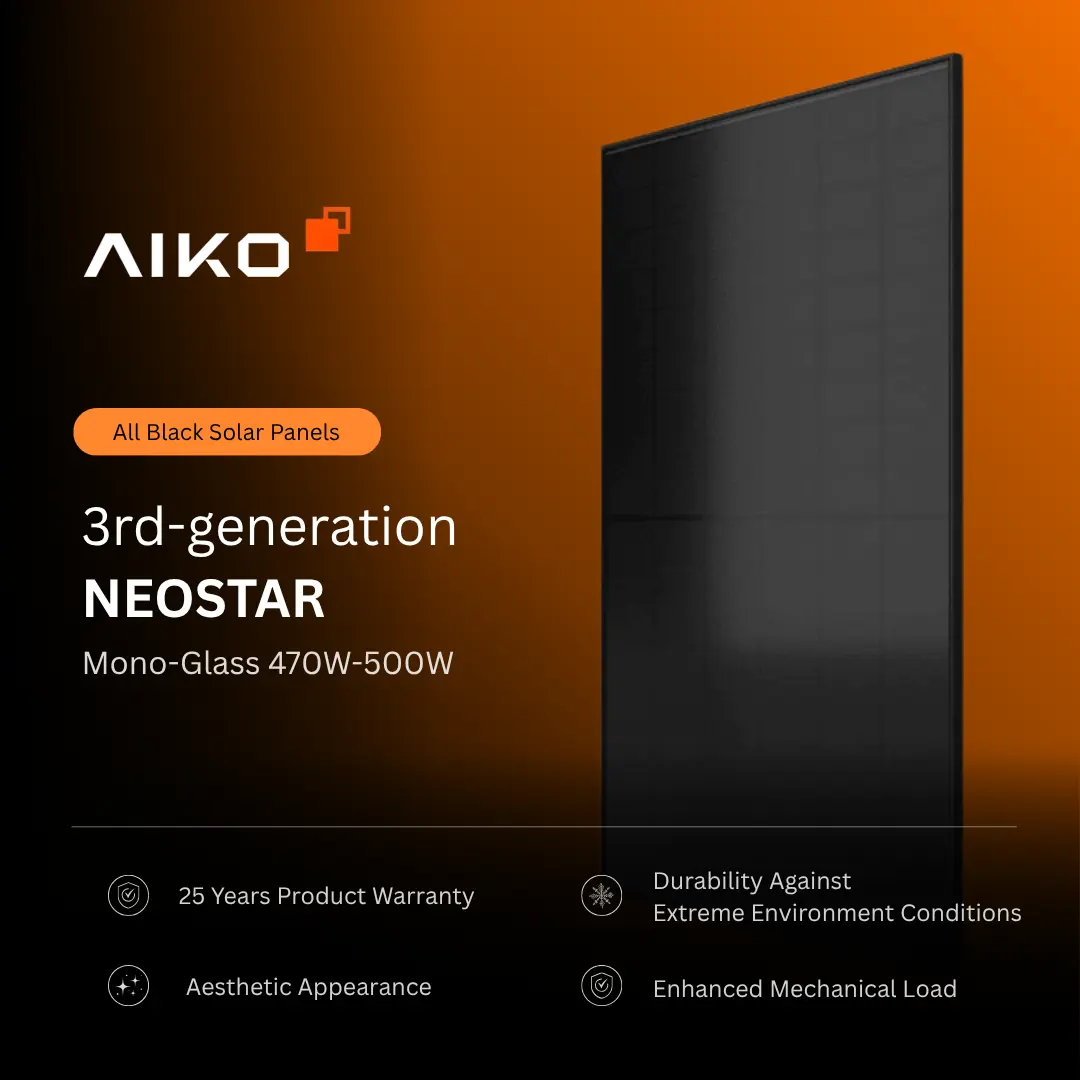
AIKO calls its technology ABC, meaning all-back-contact. Its electrical connections are also behind the cells. The NEOSTAR 3P54 delivers 470–500W and reaches 25% efficiency, placing it at the top end of current residential panel efficiency.
AIKO specifies no more than 1% first-year degradation, followed by no more than 0.35% annually, with a 30-year performance warranty. Its standard product warranty is 15 years and may be extended to 25, so establish whether an extension is included or requires registration.
Key advantages
- Higher maximum efficiency
- Shorter than the compared LONGi panel
- Clean, premium appearance
- Partial-shading optimisation
- Strong output guarantee
Things to consider
A higher percentage does not automatically create greater savings. If both proposals fit ten 500W panels, both provide 5kWp before system losses. AIKO’s advantage becomes valuable when its dimensions permit an extra panel or higher-capacity layout.
Example UK use case
A terraced house has a chimney and roof window. A shorter AIKO module allows nine panels where the LONGi layout fits eight. AIKO would probably deliver better long-term value.
Performance, shade and winter generation
Both panels work in cloudy weather and winter because solar cells use daylight, not heat. Winter output is lower because days are shorter, the sun is lower and shading is often greater.
Energy Saving Trust says an unshaded south-facing roof is ideal. East- or west-facing systems typically generate around 15–20% less than an equivalent south-facing array.
Their identical -0.26%/°C temperature coefficients mean neither has a clear heat-performance advantage. Both advertise improved partial-shading behaviour.
This can reduce losses within an affected module, but it does not make shading irrelevant or prove that separate optimisers are unnecessary. The installer should model shade and design strings around the inverter’s maximum power point tracking, or MPPT, inputs.
dule size permit more generation capacity.
AIKO calls its technology ABC, meaning all-back-contact. Its electrical connections are also behind the cells. The NEOSTAR 3P54 delivers 470–500W and reaches 25% efficiency, placing it at the top end of current residential panel efficiency.
AIKO specifies no more than 1% first-year degradation, followed by no more than 0.35% annually, with a 30-year performance warranty. Its standard product warranty is 15 years and may be extended to 25, so establish whether an extension is included or requires registration.
Which panel suits each buyer?
| Buyer | Recommended starting point | Reason |
|---|---|---|
| Small or awkward roof | AIKO | Higher efficiency and shorter module |
| Value-focused homeowner | LONGi | Close performance without chasing the final increment |
| EV owner | Whichever permits more kWp | Array size and charging schedule matter most |
| Landlord | LONGi | Sensible performance-to-cost balance |
| Design-conscious renovator | Compare all-black models | Appearance varies by model |
| Heavily shaded property | Neither without modelling | Roof design matters more than brand |
| Warranty-led buyer | Compare exact models | Brand headlines may hide differences |
How to choose the right system
- Measure usable roof area. Allow for edges, ridges, windows, chimneys and fixing zones.
- Compare total array capacity. Ten 500W panels equal 5kWp regardless of the manufacturer.
- Review yield forecasts. Check the orientation, roof pitch and assumed shading losses.
- Separate the warranties. Product, performance, workmanship, labour and scaffolding cover are different.
- Confirm inverter compatibility. Panel voltage and current must suit the proposed string design.
- Plan ahead. Discuss batteries, EV charging, heat pumps and future expansion.
- Check installer evidence. Request relevant case studies, reviews and installation photographs.
- Compare complete prices. Scaffolding, mounting, monitoring, electrical upgrades and aftercare can outweigh panel-price differences.
UK costs, savings and payback
Energy Saving Trust currently estimates about £7,600 for an average 4.5kWp domestic installation and says battery storage typically adds £5,000–£8,000. Prices vary with roof access, condition, system size, inverter and electrical work, so a survey is required.
| Installation | Broad 2026 planning allowance |
|---|---|
| 4–5kWp solar-only system | Around £6,000–£9,000 |
| Solar plus domestic battery | Around £11,000–£17,000 |
| Complex roof or premium electrical work | Survey required |
These figures are planning allowances rather than quotations. Panel supply cost is only one part of an installation. Payback depends more on annual generation, electricity prices, daytime consumption, export payments and whether battery savings justify the added expense.
Energy Saving Trust examples show payback of roughly nine to twelve years across several UK locations and household-use patterns. These are illustrations, not guarantees. Eligible systems in Great Britain can earn export payments, while qualifying installed solar panels and batteries remain zero-rated for VAT until 31 March 2027 under current rules.
Will LONGi or AIKO save more money?
The brand name alone cannot answer this. A larger AIKO layout may generate more because more capacity fits on the roof. Where both proposals have the same kWp, annual output is likely to be close, subject to the manufacturer’s performance data and the installer’s model.
Compare predicted kilowatt-hours rather than efficiency percentages alone. Also check whether the premium option changes the payback period meaningfully.
Spending several hundred pounds more for a small theoretical gain may be worthwhile on a constrained roof, but difficult to justify when system capacity, inverter and forecast generation are effectively identical.
Why the installer matters
Poor surveying or installation can cause avoidable shading losses, inverter clipping, water-ingress risks or warranty disputes.
Use an MCS-certified installer and request:
- A dimensioned roof plan
- Annual-generation forecast
- Structural assessment
- Electrical and string design
- DNO application or notification
- Commissioning records
- MCS certificate
- Monitoring setup
- Complete handover pack
Ask who diagnoses a fault, contacts the manufacturer and pays for labour or scaffolding. MCS sets standards for small-scale renewable installations and requires certified installers to issue customers with an MCS certificate after commissioning.
Frequently asked questions (FAQs)
Clear answers comparing LONGi and AIKO solar panels, including efficiency, warranties, shade performance, batteries, EV charging and likely payback periods. Speak to Simple Green Energy .
Need help comparing LONGi and AIKO?
Speak with Simple Green Energy about roof space, system capacity, panel specifications, warranties and which proposal offers the best fit for your property.
Compare my solar optionsLONGi vs AIKO: final verdict
Choose AIKO when its efficiency and compact dimensions produce a larger array. Choose LONGi when both brands provide the same system capacity and LONGi offers the stronger complete quotation.
AIKO wins the headline efficiency comparison. LONGi offers very close performance and potentially better value.
The right proposal combines a suitable layout, realistic generation estimate, compatible inverter, documented warranty and dependable installation support.
Book a free Simple Green Energy home survey: receive a roof-specific LONGi and AIKO comparison, annual-generation estimate and itemised quotation.