Boiler Service Cost UK: What Should You Pay in 2026?
A boiler service in the UK typically costs £70–£120, although prices can rise to £150 or more for oil boilers, manufacturer services, difficult access or appointments in high-cost areas. For a straightforward gas combi boiler service by a local Gas Safe registered engineer, budgeting about £100 including VAT is sensible. Recent pricing sources support this range.
This guide explains what affects the price, what a proper service includes, whether boiler cover offers better value, and how homeowners and landlords can avoid an inadequate inspection.
Speak to Simple Green Energy: Request a free, no-obligation assessment of your home heating, energy use and potential upgrade options.
Check your ECO4 eligibility
Answer a few quick questions to see whether your household may qualify for ECO4 support.
Quick answer
In 2026, most UK households should expect to pay £70–£120 for a one-off gas boiler service, with around £100 a practical average. Oil and LPG servicing can cost more because the work may involve additional cleaning, fuel-system checks or specialist competence.
The quoted service price normally covers inspection, safety and combustion checks, cleaning where required, and a service record. It usually does not include unrelated repairs or replacement parts.
Use a Gas Safe registered engineer for natural gas or LPG and an appropriately competent OFTEC registered technician for oil. An annual service is recommended and is commonly required to preserve a manufacturer guarantee.
Table of Contents
ToggleBoiler service prices at a glance
| Service type | Typical UK price | Best for | Important note |
|---|---|---|---|
| Gas boiler service | £70–£120 | Most mains-gas homes | Around £100 is a sensible budget |
| Oil boiler service | £90–£150 | Off-grid homes | Use an OFTEC registered technician |
| LPG boiler service | £90–£125 | Park homes and off-grid properties | Engineer needs the correct Gas Safe competence |
| Electric boiler service | £75–£110 | All-electric homes | Work is electrical rather than combustion-based |
| Manufacturer service | £109–£211+ | Owners wanting brand-led support | Often costs more than a local engineer |
| Boiler cover with service | Commonly paid monthly | Households wanting breakdown protection | Compare annual total, excesses and exclusions |
Suggested visual: a UK map showing typical regional price variation and an annotated cutaway of a boiler service.
These are budgeting ranges, not fixed tariffs. Condition and scope matter. British Gas currently lists a one-off service from £109, while Worcester Bosch lists manufacturer servicing from £184 for certain boilers, showing why provider choice can materially affect cost.
What is included in a boiler service?
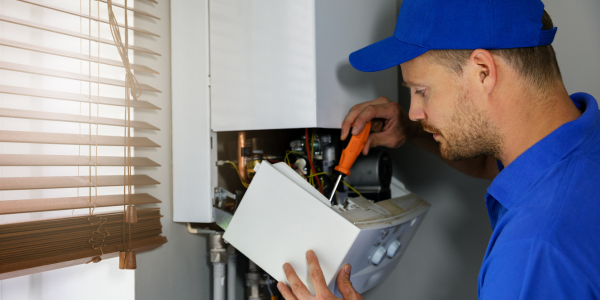
A proper service is more than a quick look at the display. The engineer should follow the boiler manufacturer’s instructions and assess whether the appliance is operating safely and correctly.
For a gas boiler, the visit may include:
- Checking the boiler’s physical condition, controls and seals.
- Inspecting the flue, ventilation and condensate route.
- Checking gas pressure, burner operation and combustion readings.
- Examining safety devices and signs of corrosion or leakage.
- Cleaning components where the manufacturer requires it.
- Restarting the boiler and confirming correct operation.
- Recording the service in the Benchmark logbook or issuing a report.
Suggested visual: a seven-step boiler-service inspection diagram, from visual checks to the final service record.
The precise tasks depend on the model. Gas Safe Register advises using a registered engineer, and its consumer guidance describes servicing as a check that the boiler is operating safely and efficiently.
A standard service normally does not include replacement parts, powerflushing, radiator repairs, system balancing, fixing an existing fault or issuing a landlord gas-safety record unless these have been agreed.
Worcester Bosch’s 2026 service schedule, for example, excludes boiler repairs, external-system repairs and landlord gas-safety checks from its annual-service price.
What affects boiler service cost?
Boiler fuel and design
Gas combi boilers are generally the most straightforward to price. Oil boilers can require burner cleaning, nozzle or filter attention and inspection of the oil supply and storage arrangements.
OFTEC recommends annual professional attention and notes that a registered technician may also inspect the oil tank.
Location and availability
Labour rates are often higher in London and other expensive urban areas. Prices can also increase during cold periods when engineers are dealing with breakdowns.
Booking in spring or summer may provide more appointment choice and lets you address faults before the heating season.
Boiler age, condition and access
An older, dirty or poorly accessible boiler may take longer. A low advertised price may assume the appliance is working normally, easy to reach and requires no remedial work.
Tell the provider about fault codes, unusual noises, pressure loss, water leaks or access restrictions before accepting a quote.
Provider and scope
Independent engineers may charge less than national or manufacturer services. Compare more than the headline price: check VAT, travel, service documentation, combustion analysis, minor consumables, and whether a gas-safety record is included.
Is an annual boiler service worth it?
For most households, yes. An annual service can identify unsafe operation and developing faults before they become urgent. Energy Saving Trust recommends yearly servicing so a boiler runs properly and economically.
Servicing is also important for warranty protection. Vaillant requires annual servicing by Vaillant or a Gas Safe registered engineer and requires the service to be recorded. Worcester Bosch similarly states that yearly servicing is a condition of its guarantee.
Always read your own terms because deadlines and evidence requirements differ.
A service is preventative maintenance, not a promise that the boiler will never fail. However, spending around £100 can be easier to budget for than an emergency call-out, repair or premature replacement.
Which? reported that consumers paid an average £156 for a one-off repair following a service in its June 2025 survey, illustrating why repair costs must be considered separately.
One-off servicing or boiler cover?
space and suit lower hot-water demand, while system boilers are often better for larger families using several hot-water outlets at once. are the main advantages of a combi boiler?
1. It saves valuable space
A combi combines heating and hot-water production in one appliance. Removing a cylinder can free an airing cupboard, while removing an old loft tank may create useful renovation space. This is particularly valuable in flats, terraces and compact homes.
Because no separate hot-water cylinder is normally required, a combi can also simplify plans for loft conversions, bathroom renovations and storage improvements. The boiler location must still meet the manufacturer’s clearance, flue, condensate and servicing requirements.
2. It provides hot water on demand
A correctly sized combi produces hot water when a tap or shower opens. You do not need to heat a cylinder in advance, and you cannot use up a fixed tank of hot water. tical limit is flow rate. The boiler may continue producing hot water, but performance can fall if two high-demand outlets run together. This is why the number of bathrooms and the household’s routine matter as much as the boiler’s advertised output.
3. It avoids stored-water heat loss
Even an insulated cylinder gradually loses heat. A combi heats only the water being used, so there is no store sitting hot all day. This can suit smaller households with modest or unpredictable hot-water use. Energy Saving Trust notes that system boilers can produce hot water efficiently for larger households, but some heat is lost from the cylinder over time. still depend on the old system’s efficiency, controls, insulation, settings, fuel price and household behaviour. Correct sizing and commissioning remain essential.
4. It has a simpler system design
A combi has fewer separate components than a regular boiler system. There is no external cylinder, cylinder thermostat or feed-and-expansion tank.
Fewer external components can mean fewer items occupying space or requiring separate maintenance. It does not make the boiler maintenance-free, however.
Energy Saving Trust recommends annual servicing by a Gas Safe registered engineer. Servicing checks safety and efficiency, identifies developing faults and may be required to keep the manufacturer’s warranty valid. t can provide good tap and shower pressure
Because a combi uses mains water, it can deliver a better shower than an older gravity-fed system—provided the incoming pressure and flow are adequate.
An installer should test both pressure and flow, ideally at a busy time of day. A larger boiler cannot overcome a restricted incoming main. This check should happen before a hot-water cylinder or storage tank is removed.
The expected hot-water flow should also be checked against the shower, bath and taps you intend to use. A high-output shower may demand more water than a smaller combi can comfortably heat.
6. It works well with modern heating controls
A combi normally needs a single-channel programmer because hot water is produced on demand. Smart thermostats, thermostatic radiator valves, load compensation and weather compensation can improve comfort and reduce unnecessary boiler cycling.
Energy Saving Trust says effective heating controls can reduce energy use. It estimates that installing and using suitable controls could save approximately £100 a year in Great Britain, although actual savings depend on the home and previous controls. ners may also be able to reduce the radiator flow temperature without changing the domestic hot-water temperature. Research cited by Energy Saving Trust found that reducing boiler flow temperature to 60°C improved efficiency by nearly 4% in the tested context. The setting must still keep the property comfortably and safely warm. s a combi boiler best for?
A combi is often a strong choice for:
- A one- or two-bedroom flat with one shower
- A terraced or semi-detached home with one bathroom
- A small family with staggered hot-water use
- A landlord replacing an existing combi like for like
- A renovation where reclaiming cupboard space matters
- A household wanting simple app-based heating control
It may also suit a three-bedroom home where occupants rarely use multiple hot-water outlets simultaneously. Property size alone does not determine suitability: measured water flow and household behaviour are more revealing.
Expert recommendation: Treat combi selection as a water-demand decision, not simply a boiler-brand decision. Confirm the incoming flow rate, identify the busiest likely period and ask the installer to explain the expected litres-per-minute delivery at winter mains-water temperatures before approving the design.
What should you consider before choosing one?
Performance can disappoint when one person showers while another fills a bath or runs a high-flow tap. Energy Saving Trust therefore says combis may be unsuitable for homes with multiple bathrooms, high hot-water demand or low water pressure. sider:
- There is usually no immersion-heater backup if the boiler fails.
- Converting from a cylinder system can be expensive.
- Gas pipework, condensate drainage or the flue may need upgrading.
- Old radiators and pipework must be suitable for a sealed, pressurised system.
- Most combis are not designed around solar-thermal hot-water storage. pump should be compared where lower-carbon heating is a priority.
A combi should not be selected simply because it is common. For a large family home with two or more bathrooms, a system boiler and correctly sized unvented cylinder may provide better simultaneous hot-water performance.
How to choose the right combi boiler
- Measure mains flow and pressure. Ask for the results rather than accepting a visual estimate.
- Calculate hot-water demand. Include showers, baths and taps that may be used at the same time.
- Size from heat loss and radiator output. Do not select a boiler from bedroom count alone.
- Check modulation. A boiler that can reduce its output during milder weather may operate more steadily.
- Compare warranties. Check the duration, annual-service conditions, labour cover and installer requirements.
- Choose compatible controls. Confirm whether load compensation, weather compensation or smart zoning is suitable.
- Inspect the existing system. Pipework, radiators, valves, the gas supply and condensate route may all affect the design.
- Demand a detailed quotation. It should cover system cleaning, controls, filters, certification, waste removal and warranty registration.
How much does a combi boiler cost?
| Buyer | Better starting option | Why |
|---|---|---|
| New boiler under guarantee | One-off annual service | The guarantee may already cover eligible component failures |
| Reliable boiler with household emergency savings | One-off service | Often the lowest annual cost |
| Older boiler with no warranty | Compare cover carefully | Repair protection may be useful, but exclusions matter |
| Landlord with several properties | Planned maintenance arrangement | Easier scheduling and record management |
| Household wanting predictable monthly costs | Boiler cover | Spreads cost, subject to excesses and limits |
A one-off service is usually best when the boiler is reliable and you can fund an unexpected repair.
Cover may suit people who value predictable costs, but compare:
- The full annual premium.
- Call-out excesses.
- Initial waiting periods.
- Maximum boiler-age restrictions.
- Limits on repair costs or replacement parts.
- Whether the annual service is guaranteed within the policy year.
- Whether controls, pumps, radiators and pipework are covered.
A boiler service alone does not normally include repairs.
How to choose the right boiler service
- Identify the fuel and model. Provide the exact boiler make, model and approximate age.
- Use the right competence. Choose a Gas Safe registered engineer for gas or LPG and check that the engineer is qualified for that appliance type. Use an OFTEC registered technician for oil.
- Request a written scope. Ask what inspections, tests, cleaning and documentation are included.
- Confirm the total price. Check whether VAT, travel, congestion charges and parking are included.
- Separate servicing from repairs. Ask how additional work will be quoted and approved.
- Protect the warranty. Confirm that the service will follow the manufacturer’s instructions and be entered in the logbook.
- Compare value, not just price. A thorough £100 service may offer better value than a rushed £60 visit.
- Keep your records. Retain invoices, reports, combustion results and guarantee evidence.
Landlords: service versus gas-safety check
Landlords must ensure supplied gas equipment is safely installed and maintained and arrange an annual gas-safety check for each relevant appliance and flue. Tenants must receive the record within the required timeframe.
Crucially, an annual gas-safety check and a boiler service are not automatically interchangeable.
The Health and Safety Executive states that landlords should not assume a service covers every required safety-check point or that a safety check alone provides effective maintenance. Ask for both tasks to be clearly listed on the quote and resulting documentation.
Why the engineer matters
Service quality affects safety, reliability, efficiency, warranty evidence and the likelihood that early warning signs are found.
Before booking:
- Check the engineer’s registration.
- Confirm competence for your boiler and fuel.
- Ask whether manufacturer instructions will be followed.
- Request a written service record.
- Ask for an explanation of any defects or advisory work.
- Do not approve unexpected chargeable repairs without a clear price.
- Be cautious of unusually short appointments or prices that appear unrealistic.
A good provider should use appropriate test equipment, explain findings without pressure and obtain your approval before fitting chargeable parts.
Frequently asked questions (FAQs)
Clear answers about boiler-service costs, annual servicing, appointment times, repairs, gas-safety checks, landlord responsibilities, warranties and the best time to book. Speak to Simple Green Energy .
Need to arrange a boiler service?
Speak with Simple Green Energy about annual maintenance, service scope, warranty requirements, landlord responsibilities, appointment timing and the condition of your boiler.
Review my boiler service optionsConclusion
Budget about £100 for a routine gas boiler service, while allowing more for oil boilers, difficult access, manufacturer servicing or combined landlord documentation.
Obtain a written quote, use the correct registered professional, and book annually before winter demand rises.
A transparent service should leave you with clear findings and usable maintenance records, not an unexpected repair bill.
Important links:
Solar panels: https://www.simplegreenenergy.org/solar-panels/
Air source heat pump: https://www.simplegreenenergy.org/air-source-heat-pump/
EV charger: https://www.simplegreenenergy.org/ev-charger/
Air conditioning: https://www.simplegreenenergy.org/air-conditioning/